How Does Light Actually Control Your Circadian Rhythm? The Science Explained
Introduction: A Mechanism Everyone Mentions, Few Actually Explain
“Light affects the body clock.” In the lighting industry, almost everyone says it. But how exactly does it happen? After light enters the eye, which path does it take? Why is blue light special? Why does “bright” not equal “effective”? Why can even a little light at night cause problems?
The answers are not in marketing language. They are in photobiology and neuroscience laboratories. This article makes no product pitch. It does one thing: explain how light regulates circadian rhythm at the level of mechanism.
Part 1: After Light Enters the Eye, It Does Not Take the “Visual” Path Alone
1.1 Visual and Non-Visual: Two Separate Photosensory Systems
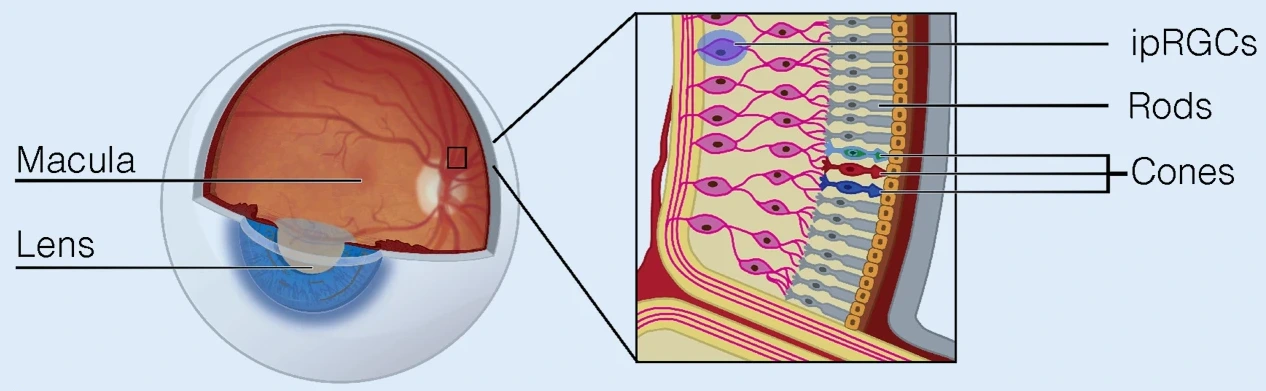
The traditional view was that the eye is for “seeing” — rods for dim light, cones for colour and detail. That picture was fundamentally changed by a 2002 discovery: the retina contains a third class of photoreceptor called intrinsically photosensitive retinal ganglion cells (ipRGCs). They do not form images, but they send signals directly to the brain’s “master clock”.
This means light entering the eye takes at least two paths:
-
Visual pathway: rods/cones → visual cortex → seeing the world.
-
Non-visual pathway: ipRGCs → suprachiasmatic nucleus (SCN) → regulation of circadian rhythm, hormones, alertness, and sleep.
These two paths are not most sensitive to the same wavelengths. Vision peaks around 555 nm (yellow-green). The non-visual pathway peaks in the 460–480 nm blue band.
1.2 Melanopsin: The Molecular Switch of the Non-Visual Pathway
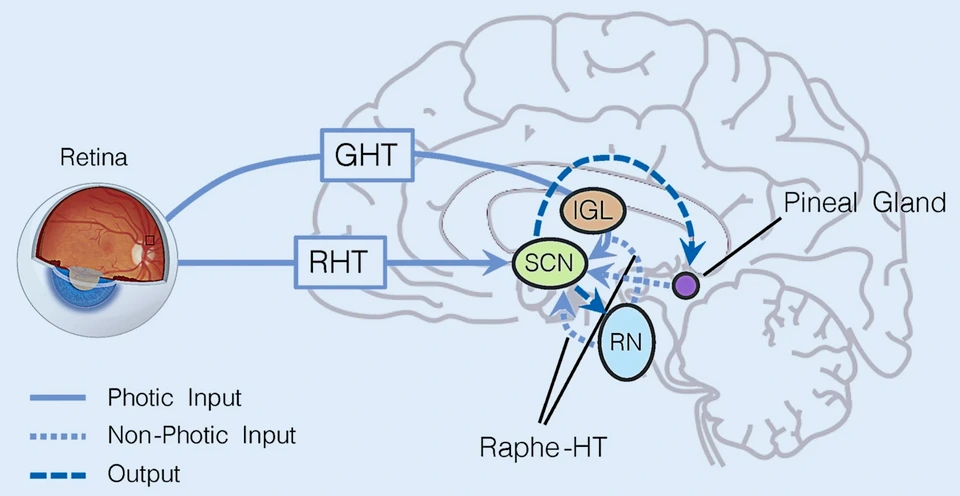
ipRGCs are photosensitive because they express a photopigment called melanopsin. Melanopsin peaks at approximately 480 nm, squarely in the blue band. When blue light strikes ipRGCs, melanopsin is activated, the cell fires action potentials, and the signal travels along the retinohypothalamic tract (RHT) directly to the SCN.
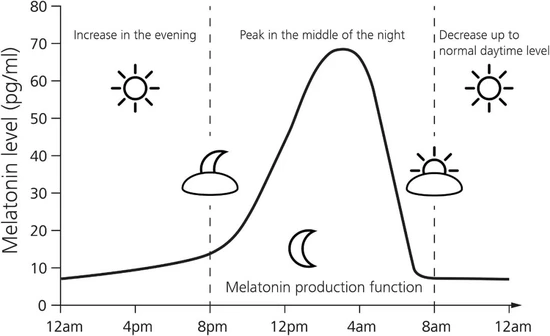
The SCN is a cluster of about 20,000 neurons per hemisphere in the hypothalamus. It is the body’s circadian pacemaker. Once the SCN receives light signals, it regulates pineal melatonin synthesis and release, core body temperature, cortisol rhythm, alertness, and cognitive performance.
Part 2: Light Suppresses Melatonin in a Dose-Dependent Way
2.1 It Is Not “Light or No Light” — It Is “How Much and What Kind”
Melatonin suppression by light is not an on/off switch. It is dose-dependent, determined mainly by two parameters: irradiance and spectral composition.
Intensity dimension:
-
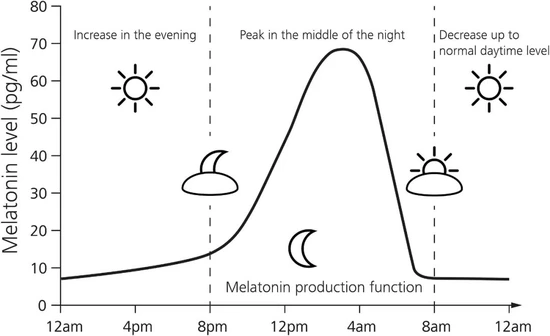
Nocturnal exposure to 0.1–5 lux of very dim light (roughly city skyglow or a nightlight) produces measurable physiological effects: partial melatonin suppression and subtle circadian phase shifts.
-
Typical indoor lighting (>500 lux) can induce near-complete melatonin suppression.
-
~10,000 lux (approximating daylight) not only suppresses melatonin profoundly but also produces robust circadian phase shifts.
One classic study placed the melatonin-suppression threshold in young men between 200 and 500 lux. Later work found that 50% suppression (ED50) occurs at approximately 100 lux, and that even below 30 lux in the evening can produce half of the maximum suppression effect.
The implication: there is no truly “safe” intensity of nighttime light for the circadian system. Even very dim indoor light can act at the biological level.
2.2 Spectral Dimension: Why Blue Light Is “Especially Potent”
At equal visual brightness, short-wavelength blue light around 460–480 nm is far more potent for the circadian system than longer wavelengths. Evening exposure to blue light or high-CCT white light significantly suppresses melatonin, delays circadian phase, and impairs sleep quality; amber or red light engages this pathway far less effectively.
But precision matters here: a light that looks “warm” visually is not automatically low in melanopic stimulation. A 3000K lamp with a residual blue peak may still have meaningful melanopic potency. CCT is a visual descriptor, not a biological dose descriptor. What determines non-visual effects is the energy in the spectral power distribution (SPD) around 480 nm, not the CCT number itself.
Part 3: What Happens When This Pathway Is Disrupted?
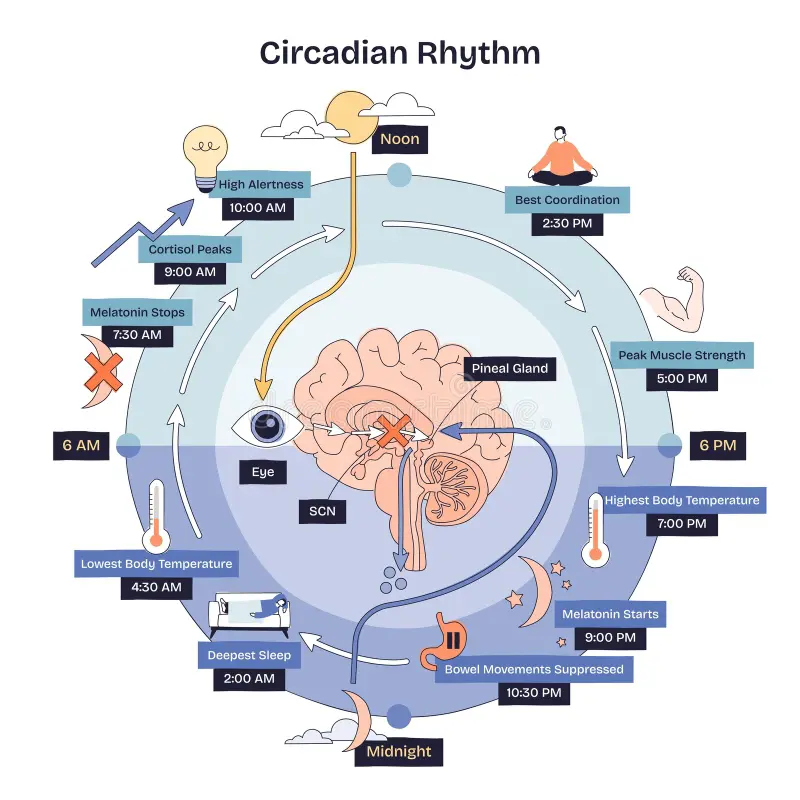
Circadian disruption is not merely “poor sleep.” When light signals arrive at the wrong time, in the wrong intensity, and with the wrong spectrum repeatedly, the SCN’s rhythmic output is weakened, and downstream physiology becomes dysregulated.
The evidence points to several consequences:
Sleep and cognition: Nighttime light exposure suppresses melatonin, delays sleep onset, and reduces sleep quality. A 16-week randomised cross-over trial in older adults found that an Enhanced Circadian Lighting System (CILS) increased deep-sleep duration from 81 ± 72 min to 128 ± 51 min, reduced nighttime awakenings from 4.56 ± 2.68 to 3.25 ± 2.03, and improved working-memory accuracy from 73 ± 22% to 85 ± 18%.
Metabolism: Irregular light exposure patterns alter circadian rhythms and impair glucose metabolism and insulin action, increasing glucose intolerance and susceptibility to diabetes. Chronic nighttime light exposure has been associated with increased prevalence of obesity and type 2 diabetes.
Mood and long-term health: Chronic circadian disruption may contribute to emotional disorders, cognitive decline, and increased risk of tumour and metabolic syndrome.
The starting point of these outcomes is often not a “very bright” lamp, but a lamp that delivers the wrong spectral signal at the wrong time.
Part 4: What This Means for Lighting
Once the mechanism is clear, the design logic changes. Three principles follow directly from the science:
1. Timing matters more than brightness. Daytime needs sufficient melanopic stimulation to “anchor” the rhythm. Evening needs a rapid reduction in melanopic exposure. Night needs the lowest possible melanopic level. The same light, placed at different times, has opposite effects.
2. Spectrum matters more fundamentally than CCT. Energy around 480 nm determines melanopic potency. A “warm” lamp that still has a blue peak can suppress melatonin at night. A genuinely night-safe light requires spectral-level reduction of the blue peak, not just lower CCT or dimming.
3. A static solution is biologically incomplete. A fixed high-CRI panel, no matter how good its colour rendering, lacks the ability to deliver “the right signal at the right time.” Circadian-effective lighting requires dynamic scheduling across the time dimension.
Part 5: How Lumin Responds to These Scientific Requirements
Understanding these mechanisms makes Lumin’s product design logic clear: we are not selling a “concept,” but providing engineering solutions for the three variables of photobiology: spectrum, intensity, and timing.
Addressing the “Daytime Dose”: PROSUN Full-Spectrum Panel (LM-PL-66-45)
Science shows that daytime requires sufficient melanopic stimulation to “anchor” the rhythm, while maintaining visual comfort. The PROSUN panel uses a sun-like full spectrum, CRI Ra 97, SDCM < 3. Its enriched red component reduces blue light hazard while providing natural color rendering. This is not just visual comfort, but reliable hardware for daytime circadian support.
Addressing the “Time Dimension & Dynamic Scheduling”: Smart Control Systems & Tunable White Panels
Science proves that static lighting is biologically incomplete. True circadian support requires light to change with a rhythm across the day. Lumin’s tunable white panels support full-range CCT adjustment from 2000K to 6500K, and can be scheduled via smart control systems (such as DALI-2, Zigbee, Tuya, etc.) to automatically tune CCT and brightness based on a time programme—waking up with high CCT in the morning, relaxing with low CCT in the evening.
Addressing “Nighttime Safety”: A60 Blue-Free Sleep Bulb (as an example of spectral intervention)
At night, the core scientific requirement is to “cut the blue peak.” This bulb uses a special phosphor formulation (not a physical filter) to directly reduce the blue energy around 480 nm, maintaining CRI ≥ 98 in 2700K mode. It proves that “intervening at the spectral level” is achievable, rather than just dimming the brightness.
Need to clarify photobiological design targets for a specific project? We can help you review spectral design, control protocols, and circadian scheduling logic. Contact Lumin’s technical team for project-specific advice →
Conclusion: Science Is the Baseline, Not the Selling Point
“Light affects the body clock” is not wrong. But it is too vague to be useful. What is actionable is this: light regulates the SCN’s rhythmic output through ipRGCs and melanopsin in a dose-dependent manner; intensity, spectrum, and timing jointly determine the effect.
When a lighting specification is built on this mechanism, product selection stops being “which one looks healthier” and becomes: at the right time, what does this source say to the 480 nm pathway — and can the system change that “statement” across the day?
Lumin’s product line covers different links in that chain: from nighttime blue-peak reduction, to daytime full-spectrum support, to dynamic scheduling. They are not footnotes to a “circadian” label. They are engineering responses to the principles above.
FAQ
Q1: Why is blue light around 480 nm so important for the body clock?
Because melanopsin in ipRGCs peaks at approximately 480 nm. At equal visual brightness, blue light in this band is far more efficient at activating the non-visual pathway — suppressing melatonin and shifting circadian phase — than longer wavelengths.
Q2: How dim does nighttime light need to be to affect melatonin?
There is no “absolutely safe” threshold. Studies show that 0.1–5 lux can produce measurable melatonin suppression and phase shifts; ~100 lux can achieve 50% suppression; and >500 lux typical indoor light can produce near-complete suppression.
Q3: Does a higher-CCT lamp always have a stronger effect on the body clock?
Not necessarily. CCT is a visual descriptor, not a reliable predictor of melanopic dose. Two light sources with the same nominal CCT can differ substantially in melanopic potency if their SPDs differ around 480 nm. Look at SPD and melanopic metrics (such as M-EDI), not CCT alone.
Q4: Why is nighttime light “more dangerous” than daytime light?
Because the same melanopic stimulus, when delivered during the biological night, suppresses melatonin and delays circadian phase; when delivered during the day, it helps “anchor” the rhythm. Timing determines direction — this is the most fundamental phase-response property of the circadian system.
Q5: Can Lumin provide measured M-EDI data for its products?
Lumin’s product designs follow the photobiological principles described above (e.g., spectral design of the blue-free sleep bulb, spectral completeness of the full-spectrum panel, scheduling capability of dynamic-control products), and spectral design documentation can be provided for project reference. Specific M-EDI certification or measured data should be confirmed separately based on project requirements.
Más allá del lux: Cómo la luz melanópica y el M-EDI moldean la salud circadiana