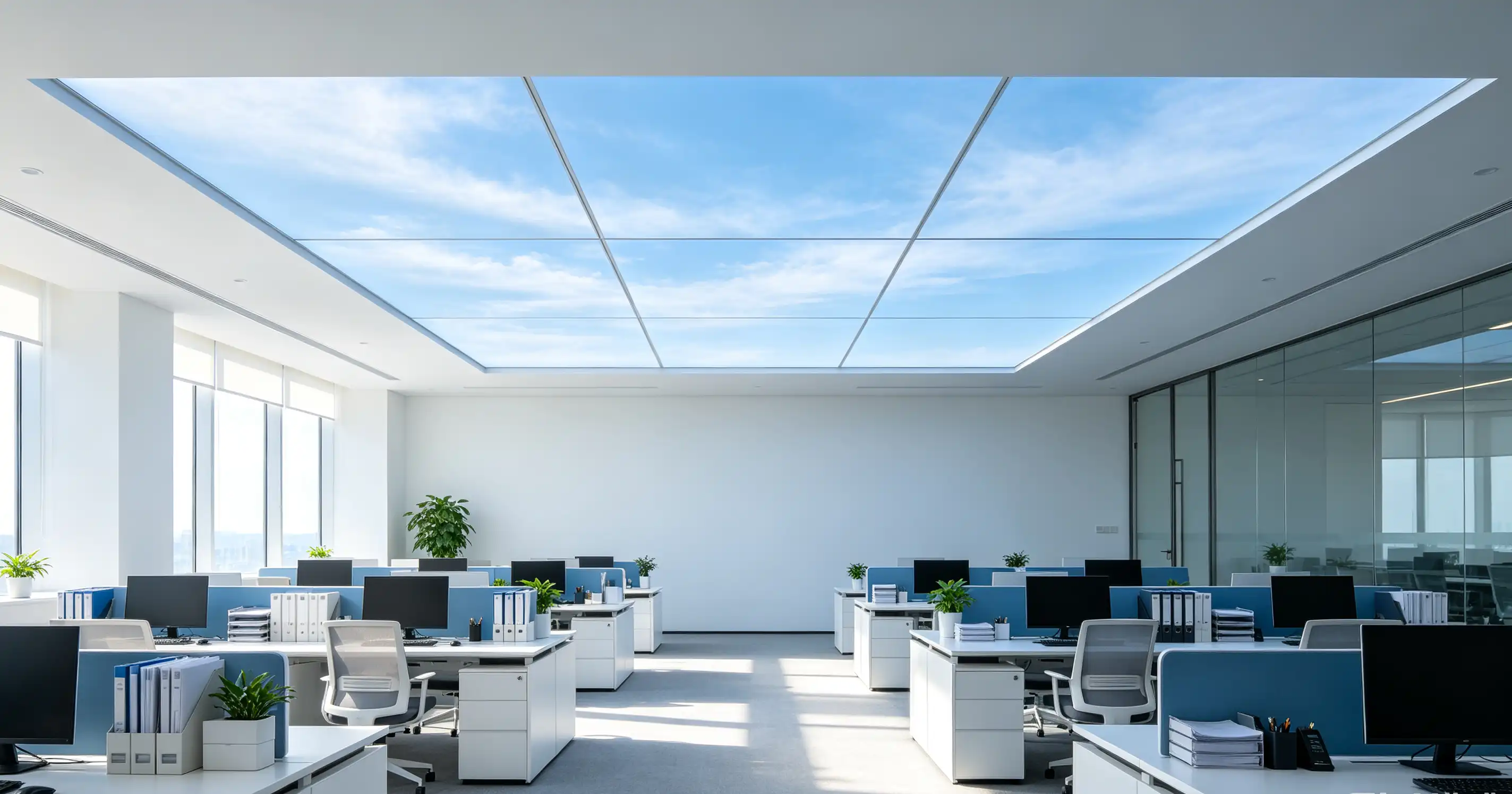
Commercial Artificial Skylights: 2026 Solutions for Healthcare & Retail

Walk into any modern hospital wing or underground shopping mall built before 2020, and you'll likely feel it within minutes: that subtle, unshakable sense of enclosure. The flat fluorescent hum, the uniform cool-white glow, the complete absence of sky or horizon. For patients recovering from surgery, this environment can extend hospital stays by days. For retail customers, it often means cutting visits short and leaving without making a purchase.
This is the problem commercial artificial skylights were built to solve—and in 2026, the technology has evolved far beyond simple printed sky panels. Today's systems replicate actual Rayleigh scattering, cast realistic 45-degree sunbeams, dynamically shift color temperature throughout the day, and even operate safely in the high-magnetic-field environments of MRI suites. For healthcare facilities and retail operators, these aren't just decorative upgrades—they're measurable investments in patient outcomes and sales revenue.
Why Natural Light Remains the Gold Standard (And Why We Can't Always Get It)
Before diving into artificial solutions, it's worth understanding exactly what we're trying to replicate. The psychological and physiological effects of natural daylight are among the most well-documented phenomena in environmental psychology. When sunlight hits our eyes, it triggers a cascade of hormonal responses: cortisol levels rise to promote alertness in the morning, serotonin production stabilizes mood, and as light fades in the evening, melatonin release prepares us for sleep. This 24-hour cycle, known as our circadian rhythm, governs everything from wound healing speed to purchasing decisions.
The challenge? In modern commercial construction, windows and real skylights are expensive, structurally complicated, and often impossible. Interior hospital rooms, basement retail spaces, MRI suites, corridor networks, and deep-plan floor plates simply cannot access natural light. Even in spaces with windows, north-facing exposures or neighboring buildings can leave areas perpetually dim. For decades, the only solution was higher-wattage fluorescent lighting—which made spaces brighter, but did nothing to address the fundamental disconnect from outdoor visual cues.
This is where modern artificial skylight technology delivers genuine transformation. Unlike traditional flat panel lights that simply illuminate a space, artificial skylights create the visual perception of looking up at actual sky. The human brain processes this differently than regular electric light—even when we consciously know we're indoors. The depth perception, the blue wavelength distribution, the subtle gradations of color all signal "open sky" to our visual cortex, triggering the same circadian and emotional responses as real daylight.
The Technology Behind 2026 Artificial Skylight Systems
The artificial skylight market has matured dramatically over the past five years. What was once a novelty product with obvious printed patterns has become a sophisticated lighting category with multiple specialized technologies for different use cases.
Rayleigh Scattering Panels: The Most Realistic Sky Effect Available
The gold standard for realism in 2026 is panels that leverage actual Rayleigh scattering principles—the same optical physics that makes the real sky appear blue. As documented in optical physics research, Rayleigh scattering occurs when light particles interact with molecules smaller than their wavelength, scattering short-wavelength blue light more strongly than longer red wavelengths. This is why the sky appears blue overhead but shifts to warm oranges and reds at sunset.
Lumin's 45° Asymmetric Beam Skylight (//www.luminlight.com/artificial-blue-skylights.html) represents this technology at its commercial best. Unlike flat panels that shine straight down, these systems project light at a 45-degree angle, creating realistic slanted sunbeams that cast natural shadows across floors and walls—exactly like sunlight pouring through a real overhead window. The patented nanoscale diffusion layers replicate atmospheric scattering, producing a deep blue sky with genuine depth perception rather than a flat printed image. Installed in a windowless patient room or retail corridor, the effect is so convincing that first-time visitors often look up twice, searching for the actual skylight opening.
Ultra-Thin Printed Panels: Versatility for Every Installation
Not every project requires the full depth simulation of Rayleigh scattering panels. For many commercial applications—especially retrofits where ceiling cavity space is extremely limited—ultra-thin UV-printed panels offer an exceptional balance of realism, cost, and practicality. At just 9mm thick, these panels can fit into virtually any standard T-bar ceiling system without modification.
The Lumin 600x600mm Frameless LED Skylight Panel (//www.luminlight.com/flicker-free-skylight-blue-sky-frameless-led-panel-light-600x600mm-40w.html) exemplifies this category. The sky and cloud imagery is applied using industrial UV printing processes that resist fading for decades, even under continuous LED illumination. Unlike older generation panels that used cheap inkjet printing that yellowed after 2-3 years, modern UV-cured inks maintain color accuracy for 50,000+ hours of operation—essentially the full lifespan of the LED diodes themselves. These panels are available in standard sizes (600x600mm, 1200x600mm) as well as circular formats, custom dimensions, and even photo-replaceable versions where facilities can swap out sky imagery seasonally.
Dynamic and Tunable White Systems: Circadian Alignment
For healthcare environments in particular, static sky imagery is only half the solution. Research published in the Journal of Sleep Research (via PMC) demonstrates that patients in hospital rooms with dynamic lighting that mimics natural daylight cycles experience 46 minutes more sleep per night on average, with significantly reduced delirium rates in elderly populations. This is where dynamic artificial skylight systems deliver their greatest value.
Using technology adapted from high-resolution LED displays, dynamic skylight panels can shift color temperature from warm 2700K sunrise tones through bright 6500K midday blue, then back to warm sunset hues in the evening. These systems are available with multiple control options: DALI DT8 for professional building automation integration, Bluetooth mesh for wireless control, 2.4GHz RF for simple retrofits, and WiFi for app-based management. The RGBW tunable sky panels (//www.luminlight.com/artificial-sky-light-.html) take this a step further, allowing facilities to program custom scenes—soft pink sunsets for pediatric wings, bright energizing blue for retail morning hours, or gentle warm white for evening patient comfort.
Specialized Solutions for Challenging Environments
What truly separates commercial-grade artificial skylights from consumer products is the range of specialized variants engineered for specific commercial challenges:
- IP65 Waterproof Panels: Rated for wet locations, these 24V safety extra-low voltage panels are suitable for shower areas in hospital patient rooms, spa facilities, and covered outdoor retail walkways where moisture exposure would destroy standard lighting.
- Non-Magnetic MRI-Safe Panels: Constructed entirely from non-ferrous materials including 6063 aviation aluminum alloy with zero ferromagnetic components, these panels are specifically designed for MRI suites where standard lighting would create catastrophic safety hazards in the 1.5-3.0 Tesla magnetic field. The Lumin Non-Magnetic 35W MRI Skylight (//www.luminlight.com/artificial-sky-light-.html) operates at 24V with RF-shielded drivers to prevent image interference while providing calming sky imagery that reduces patient claustrophobia during scans.
- Wall and Window-Mounted Systems: Not all artificial skylights belong in the ceiling. Wall-mounted "virtual window" panels create the illusion of looking out at a garden or sky view, perfect for basement offices, interior exam rooms, and retail back-of-house spaces where even ceiling skylights aren't an option.
- Circular and Custom Shapes: Beyond standard square and rectangular panels, circular skylights create stunning focal points in lobbies, reception areas, and luxury retail environments, while fully custom shapes allow architects to integrate sky lighting into virtually any design vision.
Artificial Skylights in Healthcare: Improving Outcomes and Reducing Costs
The healthcare sector has emerged as the fastest-growing market for commercial artificial skylights, and for good reason: the return on investment is measurable in both clinical outcomes and operational costs. Multiple peer-reviewed studies now confirm that access to nature views and natural light cycles accelerates patient recovery, reduces pain medication requirements, and improves staff performance.
Patient Recovery and Clinical Outcomes
The clinical evidence for biophilic lighting in healthcare is now overwhelming. A 2025 study published in PMC (PubMed Central) examining dynamic lighting in hospital units found that patients exposed to circadian-aligned lighting experienced advanced circadian phase alignment, 35% longer nocturnal sleep duration, and significantly higher self-reported alertness in the morning. For post-operative patients, better sleep directly translates to faster recovery times and shorter hospital stays.
Another retrospective study of 18,000+ patient admissions found that circadian-aligned lighting reduced patient falls by 29%—a critical metric in healthcare, where falls are the most commonly reported safety incident and a leading cause of extended hospital stays. The mechanism is straightforward: when patients' circadian rhythms are properly aligned, they experience less midnight disorientation, better balance, and improved cognitive function during overnight hours.
For MRI suites specifically, the case for artificial skylights is particularly compelling. Up to 37% of patients experience some degree of claustrophobia during MRI scans, with 10-15% unable to complete scans without sedation. Installing sky panels above the MRI bore has been shown in multiple clinical audits to reduce claustrophobia-related scan cancellations by up to 40%, eliminating the need for sedation in many patients and increasing suite throughput. The non-magnetic construction of purpose-built MRI skylights ensures no interference with imaging equipment, while the calming blue sky and cloud visual gives patients something open and peaceful to focus on during what can be a 45-60 minute procedure in a tight, noisy tube.
In intensive care units (ICUs), where patients may remain for weeks without access to natural light, artificial skylights that simulate dawn-to-dusk cycles help prevent ICU delirium—a condition affecting up to 80% of mechanically ventilated patients that is associated with significantly higher mortality rates and long-term cognitive impairment. The simple visual cue of a blue sky during daytime and warm light in the evening helps patients maintain orientation to time, reducing the terrifying disorientation that comes with being in a windowless, 24-hour-lit environment.
Staff Performance and Wellbeing
The benefits aren't limited to patients. Healthcare workers operating in windowless environments for 12-hour shifts also experience circadian disruption, fatigue, and reduced alertness. Multiple staff surveys in facilities that have installed artificial skylights report significant improvements in perceived energy levels, mood, and job satisfaction. In high-stress environments like emergency departments and surgical suites, reducing staff fatigue isn't just a quality-of-life issue—it directly impacts patient safety and reduces medical errors.
Practical Implementation Considerations for Healthcare Facilities
For hospital facility managers considering artificial skylight installation, there are several key factors to evaluate:
- Certifications and Safety: Ensure all panels carry appropriate medical facility certifications including UL/cUL, CE, and RoHS. For MRI environments, verify ASTM F2503 testing for MR Conditional classification.
- Flicker-Free Operation: All medical lighting must be completely flicker-free (IEEE 1789 compliant) to prevent headaches, eye strain, and interference with medical equipment.
- Control Integration: Prioritize systems that integrate with existing building automation via DALI or 0-10V control, allowing staff to adjust scenes for different procedures and times of day.
- Installation Flexibility: Ultra-thin 9mm panels work with existing T-bar ceiling grids for minimal-disruption retrofits, while deeper Rayleigh scattering systems may require slightly more ceiling cavity depth in new construction projects.
Artificial Skylights in Retail: Driving Sales and Enhancing Customer Experience
If the business case for artificial skylights in healthcare is built on clinical outcomes, in retail it's built on hard sales data. The impact of natural light on retail performance has been studied extensively, and the numbers are remarkable: one landmark study by the California Energy Commission found that retail stores with skylights averaged 40% higher sales than identical stores without skylights, with 99% statistical confidence.
The Science of Light and Purchasing Behavior
Why does seeing sky make people spend more money? The answer lies deep in human evolutionary psychology. For 99.9% of our evolutionary history, open sky meant safety, open space, and access to resources. Enclosed, dark spaces triggered threat responses—wariness, a desire to exit quickly, reduced comfort. When customers feel safe and relaxed, they stay longer. When they stay longer, they browse more. When they browse more, they buy more.
Research from neuromarketing studies confirms that 95% of purchasing decisions occur unconsciously, and environmental factors like lighting quality shape these decisions far more than most retailers realize. Harsh, flickering fluorescent lighting creates subtle physiological stress responses: elevated cortisol, increased muscle tension, subconscious desire to escape the environment. Soft, natural daylight-quality lighting does the opposite: it reduces stress, encourages exploration, and makes products appear more attractive.
Full-spectrum natural light also renders colors more accurately. In fashion retail, this means fabrics appear in their true colors, reducing return rates from customers who discover items look different at home than they did under store lighting. In grocery and fresh food retail, natural-spectrum light makes produce appear fresher and more vibrant. In luxury retail, the open, spacious feeling created by artificial skylights enhances the perception of premium value, making customers more receptive to higher price points.
Real-World Retail Applications
Artificial skylights deliver particular value in specific retail scenarios:
Underground and Interior Mall Spaces: Many shopping malls, particularly in dense urban areas, have large interior zones and basement levels with zero access to natural light. These areas traditionally suffer from lower foot traffic and reduced sales compared to street-level or atrium-adjacent spaces. Installing artificial skylights transforms these dead zones into desirable retail locations. Dynamic panels can even simulate passing clouds and subtle light variations throughout the day, creating a constantly engaging environment that encourages shoppers to explore deeper into the mall rather than sticking to perimeter entrances.
Windowless Boutiques and Pop-Ups: Small independent retailers and pop-up shops in interior locations can now create the same open, airy feel previously only available to street-level stores with large windows. The ultra-thin 9mm panels install easily into standard suspended ceilings without major renovation, making them accessible even for tenants on short leases.
Big Box and Warehouse Retail: Large-format retail stores with high ceilings and deep floor plates often have dark center zones far from exterior windows. Artificial skylights installed in these central areas create visual destination points, draw customers deeper into the store, and reduce the "warehouse" feeling that makes shoppers focus only on planned purchases rather than browsing.
Hospitality and Food Service: Restaurants, cafes, and food courts within retail environments also benefit dramatically. Customers stay 20-30% longer in daylit spaces, ordering additional courses, drinks, and desserts. For quick-service restaurants, the bright, open atmosphere increases table turnover by making guests feel comfortable without lingering too long.
Choosing the Right System for Retail Environments
For retail operators, the ideal artificial skylight configuration depends on the specific environment and brand positioning:
- High-Traffic Common Areas: Durable, low-maintenance UV-printed panels in standard 600x600mm sizes offer excellent value for corridors, food courts, and entrance areas.
- Luxury Retail and Flagships: 45° Rayleigh scattering panels with realistic sunbeam effects create a premium "wow" factor that justifies the higher investment, creating Instagram-worthy moments that drive organic social media sharing.
- Seasonal Campaigns: RGBW dynamic panels allow retailers to shift lighting scenes for holiday seasons, product launches, and special events—warm golden light for Christmas, bright fresh tones for spring collections, dramatic sunset scenes for evening events.
- Wet Areas and Outdoor Retail: IP65 waterproof panels work for garden centers, pool supply stores, and covered outdoor shopping areas.
Beyond Aesthetics: The Business Case in 2026
As we move through 2026, artificial skylights are transitioning from "nice-to-have" design features to standard specifications for commercial construction and major renovations. The energy efficiency argument alone is compelling: modern LED skylight panels consume less than 0.5W per square foot, often using less energy than the traditional fluorescent panels they replace while delivering dramatically better lighting quality.
But the real ROI comes from the secondary effects: faster patient recovery reducing healthcare costs, higher sales in retail environments, reduced staff turnover in windowless workspaces, and improved brand perception. For new construction, the incremental cost of installing artificial skylights instead of standard flat panel lighting is typically less than 2% of total project cost—an investment that pays for itself many times over through the lifetime of the space.
Perhaps most importantly, these systems fulfill a fundamental human need that architecture has struggled with since we first started building deep-plan, multi-story structures: the need to see sky. As human beings, we are evolutionarily wired to respond to open sky, natural light cycles, and the visual cues of day and night. For the millions of people who spend their days working, shopping, healing, and waiting in windowless spaces, artificial skylights don't just make spaces look better—they make us feel more human.
Whether you're designing a new hospital wing seeking to improve patient outcomes, a retail operator looking to increase dwell time and sales, or an architect tasked with transforming a challenging windowless space, there has never been a better time to explore commercial artificial skylight solutions. The technology is proven, the costs are accessible, and the benefits—for health, for business, and for human wellbeing—are impossible to ignore.
References and Further Reading
- Rayleigh scattering optical principles: HandWiki Physics: Rayleigh scattering - //handwiki.org/wiki/Physics:Rayleigh_scattering
- Dynamic lighting impact on hospital patient sleep: The Impact of Dynamic Lighting on Sleep Timing and Duration for Hospitalised Patients, PMC 2025 - //pmc.ncbi.nlm.nih.gov/articles/PMC12353654/
- Light effects on circadian rhythms, sleep and mood: Effects of light on human circadian rhythms, sleep and mood, PMC 2019 - //pmc.ncbi.nlm.nih.gov/articles/PMC6751071/
- Circadian lighting and fall reduction in hospitals: Circadian Lighting Was Associated with a Reduction in the Number of Hospitalized Patients Experiencing Falls, PMC 2025 - //pmc.ncbi.nlm.nih.gov/articles/PMC12294480/
- Skylight impact on retail sales performance: Daylight and Retail Sales, Eneref Institute - //eneref.org/reports/eneref_daylight_retail_bigbox.pdf
- MRI room non-magnetic lighting safety standards: T-BAR Frame Lights for MRI Rooms: Non-Magnetic Requirements - //www.jcelighting.com/blogs/wiki/t-bar-frame-lights-for-mri-rooms-non-magnetic-requirements
Artificial Skylight Panels for Offices: Boost Productivity & Wellbeing