
Continuous Linear Lighting Systems Design Guide: Complete Solution for Large Commercial Interiors
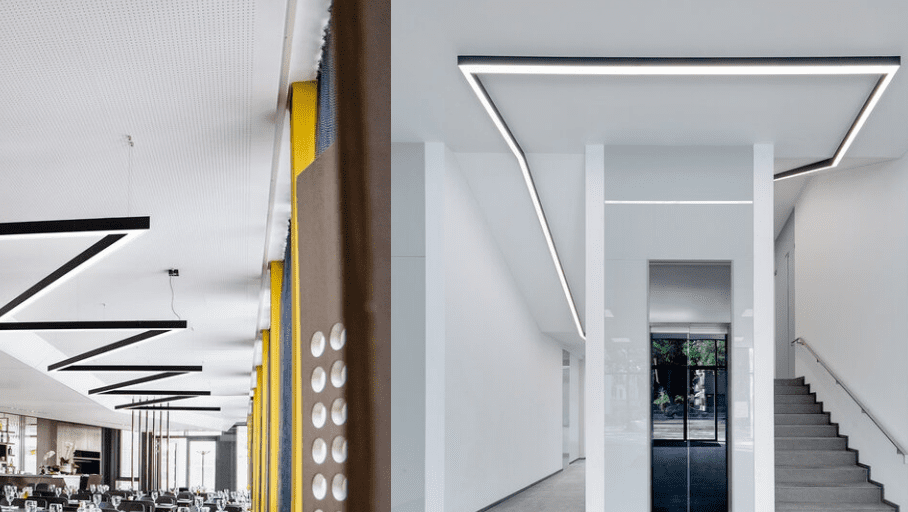
In the lighting design of large commercial spaces, one trend is becoming increasingly clear: designers are no longer satisfied with point-source lighting that merely "illuminates" — they are pursuing linear lighting that "shapes" space.
From open-plan offices to high-end retail stores, from transportation hubs to hotel lobbies, continuous linear lighting systems are becoming the mainstream language of architectural lighting.
Why? Because continuous linear lighting not only provides uniform and comfortable illumination — more importantly, it can define space, guide traffic flow, and create rhythm. This article will provide a complete analysis of the design essentials of continuous linear lighting systems and demonstrate how Lumin achieves this design philosophy through modular products.
1. What Is a Continuous Linear Lighting System?
A continuous linear lighting system, as the name suggests, involves connecting multiple linear luminaires end-to-end seamlessly to form one or more continuous, visually uninterrupted bands of light.
Compared to traditional point-source lighting (downlights, spotlights), the core characteristics of a continuous linear lighting system are:
1. Modular Splicing — Each luminaire is an independent module that connects end-to-end via dedicated connectors. Designers can flexibly adjust the total length according to spatial dimensions.
2. Seamless Connection — No visible dark spots or gaps at the joints; light remains uniform and consistent across the entire band.
3. Flexible Layout — Not limited to straight lines; with corner modules, L-shapes, T-shapes, X-shapes, and even curved layouts are possible.
4. Unified Power and Control — The entire system is driven by a unified power solution, supporting DALI, 0-10V, and other dimming protocols.
At the product level, Lumin offers two complete continuous linear lighting solutions:
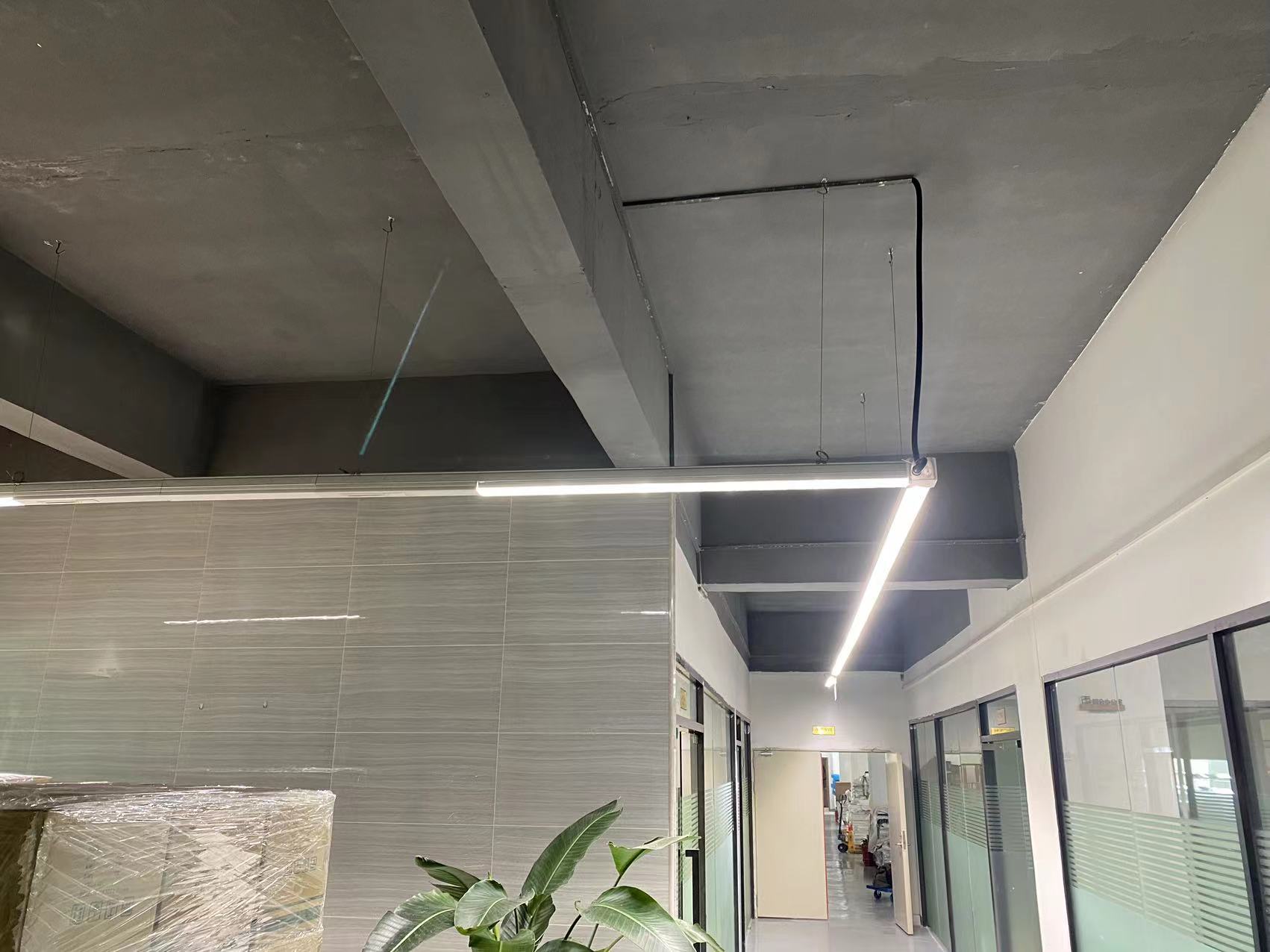
The X1 6870 Track Lighting System offers a more "industrial" continuous lighting solution. Its core is a pre-wired track, with luminaires that can be installed through tool-free 60-second quick splicing . The track comes pre-wired with 3-wire/5-wire/7-wire/8-wire/12-wire circuits, supporting 3-phase circuit switching — allowing independent group control of luminaires in different zones through three switches. Track lengths are available in 600mm/1200mm/1500mm, with luminaires matching the track length to form a complete continuous lighting system . The X1 6870 also supports DALI and 0-10V dimming modes, can integrate emergency battery/UPS systems, and is compatible with microwave sensors and daylight sensors. Through X, L, and T standard modular node connectors, various layout configurations can be achieved. Its optical system covers 30° to 120° beam angles and double-symmetrical distribution, adapting to different spatial requirements.
The UltLine X2 Series is a premium linear light range featuring a slim, minimalist design with up to 130 lm/W luminous efficacy. Its magnetic seamless connection enables perfect continuous light band splicing. It offers 7 optical kit options (prismatic, opal diffuser, louver grill, honeycomb, etc.) and 5 mounting methods (suspended, surface, recessed, wall, track), with UGR as low as 14 and CRI up to 98, meeting diverse requirements from office to high-end commercial spaces.
2. Why Do Large Commercial Spaces Prefer Continuous Linear Lighting?
1. Uniform Illumination, Eliminating Dark Spots
In open-plan spaces, point-source lighting tends to create uneven brightness. Continuous linear lighting eliminates dark spots and excessive shadows through evenly distributed light, providing consistent illumination across the entire space. This is particularly important for offices (recommended 30-50 foot-candles) and corridors (recommended 20-30 foot-candles).
2. Guiding Traffic Flow, Defining Space
Linear light bands are inherently directional — they act like "arrows" in space, guiding visual attention and pedestrian flow. In open-plan offices, linear lights can help define work zones, meeting areas, and circulation paths; in retail spaces, they can guide customer browsing routes.
3. Creating Rhythm and Depth
By adjusting the spacing, width, direction, and color temperature of light bands, designers can create rich visual rhythms in space. Continuous light bands create an elegant cohesion across open floor plans, giving spaces both order and dynamism.
4. Minimalist Aesthetics, Integrated with Architecture
Contemporary architectural lighting is shifting from "visible luminaires" to "invisible light." Continuous linear lighting systems allow luminaires to be embedded in ceilings, walls, or even furniture, achieving a "light without visible fixtures" minimalist effect. The 2026 linear lighting market trends report also明确指出 that preference for modular and continuous linear luminaires is increasing.
3. Design Essentials: Layout Planning, Splicing Methods, and Power Distribution
1. Layout Planning — Starting from Function
Lighting design begins with defining the purpose of the space. When designing a continuous linear lighting system, three questions must be answered first:
-
What are the functional zones of the space? — Work areas require higher illuminance (500-750 lux), while corridors and lounge areas can be lower.
-
What visual rhythm do you want to create? — Dense parallel light bands create a sense of order; sparse independent light bands create openness; varying spacing creates dynamism.
-
Is zoned control needed? — Do different areas require independent switching or dimming?
2. Splicing Methods — From Straight Lines to Grids
The layout of continuous linear lighting systems goes far beyond "a single straight line." Modern modular systems support multiple splicing configurations:
| Layout Type | Best For | Visual Effect |
|---|---|---|
| Single-line straight | Corridors, passageways | Guides traffic flow, clean and powerful |
| Parallel multi-line | Open offices, retail areas | Strong sense of order, uniform coverage |
| Grid pattern | Large open spaces | Strong spatial presence, visually rich |
| L-shape/T-shape/X-shape | Corners, intersections | Adapts to building structure, flexible transitions |
| Curved/arc | Showrooms, reception areas | Soft, artistic feel |
Lumin's X1 6870 track system achieves various layout configurations through X, L, and T standard modular node connectors. UltLine X2 achieves straight-line continuous splicing through magnetic seamless connection, with shape customization also available.
3. Power Distribution — Critical Technical Details
Power distribution is the core of whether the entire system can operate stably:
Load Calculation: For the X1 6870 system, the track uses 2.5mm² solid copper wires with a maximum load current of 12A. The maximum load wattage for a single set of live and neutral wire splicing is 2640W (200-240V) , with a maximum length of 89 meters (200-240V). A single circuit can support up to 44 units of 60W luminaires.
Phase Selection: The 5-wire track of X1 6870 contains 3 live wires (L1/L2/L3) , and through the phase selection terminals in the track, luminaires can be connected to different circuits. Three external switches connected to the three live wires enable easy group management of different luminaires within the system.
Functional Wire Expansion: Wires beyond the 5-wire configuration are functional wires for dimming and emergency functions. The 7-wire/8-wire/12-wire versions support DALI dimming and emergency power integration.
4. Visual Effects: How to Create Spatial Rhythm and Depth with Linear Lighting
Continuous linear lighting is not just about "illuminating" space — it's a design tool that shapes spatial perception.
1. Rhythm
The spacing and density of light bands determine the rhythm of space. In open-plan offices, evenly distributed parallel light bands create order and professionalism; in retail spaces, varying spacing can guide customer attention from one product to another.
2. Direction
The direction of linear light bands affects how people perceive space. Longitudinal arrangements stretch the depth of space; transverse arrangements emphasize the width of space; diagonal arrangements create dynamism and energy.
3. Layering
By combining direct lighting and indirect lighting, rich spatial layers can be created. The UltLine X2 series offers an optional indirect lighting module (30% of total wattage) , which produces soft ambient light by illuminating the ceiling upward, creating layered contrast with downward direct light.
4. Color Temperature Narrative
Color temperature is a powerful tool for shaping spatial mood:
-
2700K-3000K: Warm, inviting — ideal for hotels, high-end retail
-
3500K-4000K: Neutral, professional — ideal for offices, schools
-
5000K-6500K: Cool white, bright — ideal for showrooms, healthcare environments
5. Project Case Studies
Case Study 1: Large Open-Plan Office
Challenge: A 2,000㎡ open-plan office requiring uniform illumination, low glare, and visual delineation of different functional zones.
Solution: Lumin X1 6870 track system installed in a parallel multi-line layout. The 3-circuit switching function enables independent control of work areas, meeting areas, and lounge zones through three switches. 4000K neutral white light, with pre-wired tracks ensuring stable power supply. The overall system supports DALI dimming, automatically adjusting brightness based on natural daylight changes.
Results: Employees reported significantly improved visual comfort, spatial layers are clearly defined, functional zones are naturally delineated by light bands, and overall energy consumption has been reduced by over 30%.
Case Study 2: High-End Retail Space
Challenge: A 500㎡ clothing retail store requiring a flexible lighting environment adaptable to seasonal display changes, while reinforcing brand identity through lighting.
Solution: Lumin UltLine X2 series installed in a grid pattern layout. CRI 98 high color rendering ensures accurate color presentation of garments, while UGR<19 low glare provides a comfortable shopping experience. DALI control system enables independent dimming of display areas, fitting rooms, and checkout zones, with color temperature flexibly switching between 3000K-4000K to adapt to different seasons and display themes.
Results: The store can rapidly switch lighting environments based on seasonal and display needs. Customer dwell time has increased, fitting room feedback indicates "the lighting makes people look better," and overall store sales have increased by approximately 15%.
6. How to Choose the Right Continuous Linear Lighting System?
| Requirement | X1 6870 Track System | UltLine X2 |
|---|---|---|
| Design Style | Industrial, modular, high flexibility | Minimalist, slim, high efficacy |
| Mounting Methods | Track-mounted (surface or cable suspension) | 5 types (suspended/surface/recessed/wall/track) |
| Splicing Method | Mechanical node connection (X/L/T type) | Magnetic seamless connection |
| Efficacy | 160 lm/W | 100-130 lm/W |
| CRI | >80 | >80 / >90 / >98 |
| UGR | 22 | 14 / 19 / 22 selectable |
| Control Protocols | DALI / 0-10V | DALI / 1-10V / Triac / Wireless |
| Circuit Control | 3/5/7/8/12-wire | Single circuit |
| Best For | Large commercial, showrooms, transportation hubs | Offices, retail, education, commercial |
7. Conclusion
Continuous linear lighting systems are redefining the lighting language of large commercial spaces. They are not just "brighter lights" — they are architectural design elements that can define space, guide traffic flow, and create rhythm.
Lumin offers two complete continuous linear lighting solutions:
-
X1 6870 Track System: Built around tool-free quick installation (60 seconds), multi-circuit independent control (3/5/7/8/12-wire), high load capacity (12A/2640W) , and modular layout — ideal for large commercial projects, showrooms, and applications requiring flexible adjustments
-
UltLine X2 Series: Built around minimalist design, high efficacy (130 lm/W), low glare (UGR<19), high CRI (98) , and magnetic seamless splicing — ideal for projects pursuing premium light quality and modern aesthetics
Whether your project is a 2,000㎡ open-plan office, a 500㎡ retail store, or a large transportation hub, Lumin has a continuous linear lighting solution to match.
Want to learn more about product details and project case studies of Lumin X1 6870 and UltLine X2? Download the Lumin product catalog or contact our technical team for professional advice.
📞 Contact Us
📍 Address: F3, Building 1, Baolu Technology Park, Shiyan Street, Bao'an District, Shenzhen, Guangdong, China
📧 Email: sz@luminlight.com / info@luminlight.com
📱 Phone: +86 15875556677
📥 Download Product Catalog: Lumin Product Catalog Download Page
Linear Lighting vs Troffer Lighting: Which Is Better for Commercial Projects? Complete Comparison Guide


