
What is Circadian Lighting and How Does It Support Human Circadian Rhythm?

Have you ever walked into a windowless office at 9 a.m. and felt drowsy and unfocused before you even started your first task? Or worked a full shift in an underground meeting room and walked out feeling as if your internal clock had drifted by hours? Chances are the problem was not your sleep schedule — it was the quality of indoor light around you.
Our bodies did not evolve under constant, flat, flickering ceiling light. We evolved under the sun, whose brightness and spectrum shift naturally from dawn to dusk. When buildings strip away that daily rhythm, our biology suffers. This is precisely the gap that circadian lighting is designed to close — and it is one of the fastest-growing categories in modern human-centric lighting design.
In this guide, you will learn exactly what circadian lighting is, the science of melanopic light and M-EDI, how it differs from ordinary tunable white, and how Luminlight manufactures circadian lighting systems for commercial projects — including our own artificial skylight range for windowless spaces.
1. What Is Circadian Lighting?
Circadian lighting, also known as biological or non-visual lighting, is a branch of human-centric lighting (HCL) that mimics the natural daily changes of sunlight in order to support our body's 24-hour biological clock — the circadian rhythm.
A circadian lighting system does not simply turn a lamp on and off. It continuously adjusts three parameters throughout the day:
- Spectral composition — the balance of blue, green and warm light, which determines how strongly the light stimulates our biological photoreceptors;
- Intensity (illuminance) — brighter, higher-content light in the morning, softer light toward evening;
- Correlated colour temperature (CCT) — cooler, daylight-like light in the morning, warmer tones as the day winds down.
The goal is simple but profound: to give the body the same "light signals" it would receive from real sunlight, so that melatonin, cortisol, alertness and sleep all stay aligned with a healthy rhythm.
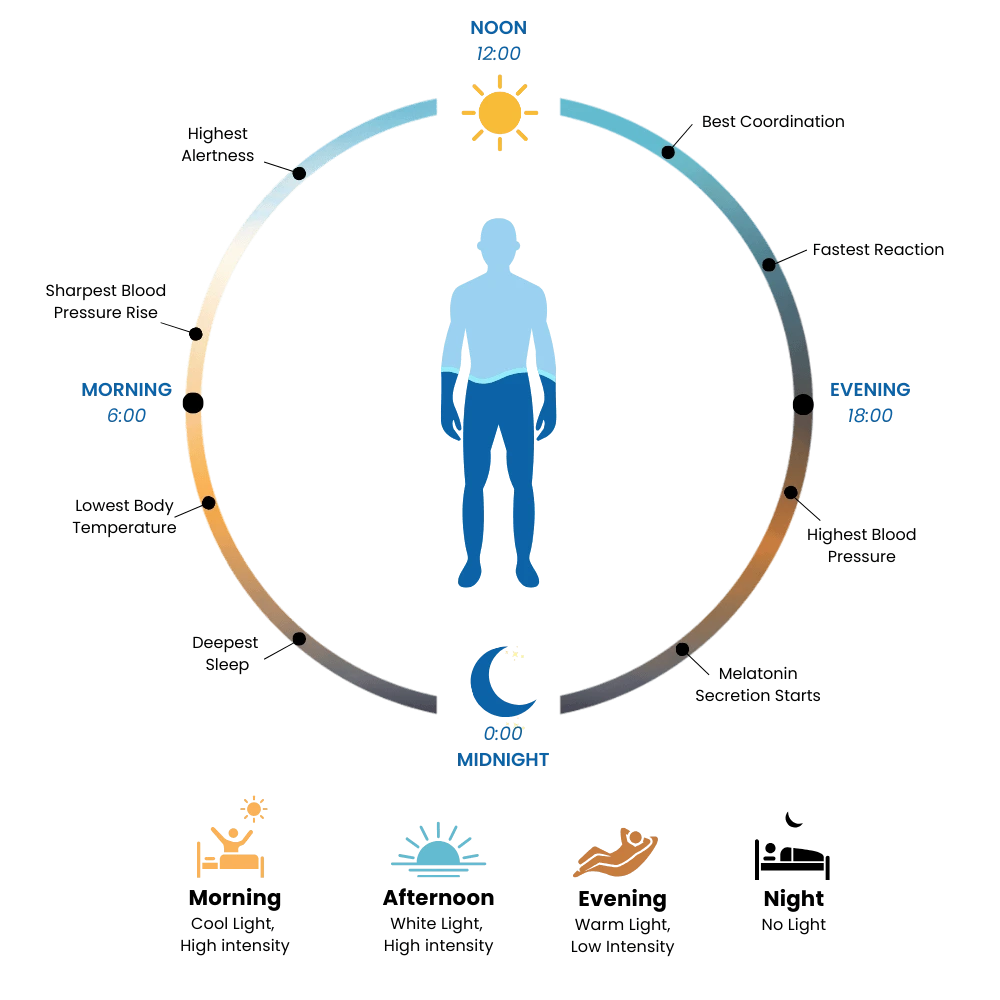
Traditional lighting only helps us see. Circadian lighting helps our bodies work.
2. The Biology Behind It: ipRGCs and Melanopic Light
To understand why circadian lighting works, we have to look beyond the rods and cones that let us see. In 2002, scientists discovered a third class of light-sensing cells in the human eye called intrinsically photosensitive retinal ganglion cells (ipRGCs).
These cells do not form images. Instead, they detect light — particularly short-wavelength "blue" light — and send signals along a dedicated pathway to the suprachiasmatic nucleus (SCN), the master clock of the brain. This non-visual signal is what tells your body whether it is day or night.
The biological response of these cells is quantified through melanopic light, the portion of light that stimulates melanopsin, the photopigment inside ipRGCs. A light source may look perfectly normal to our eyes yet be weak in melanopic content — and therefore weak at regulating our body clock.
This is why "any bright light" is not enough. A circadian lighting system is engineered specifically to deliver adequate melanopic light at the right time of day, and to suppress it at night to protect melatonin secretion.
3. The Industry Metric That Matters: M-EDI
Because standard lux meters measure only visual brightness, lighting designers needed a separate metric to quantify biological impact. That metric is the Melanopic Equivalent Daylight Illuminance, or M-EDI, measured in lux-equivalent units.
Here is how to read it:
- High M-EDI light in working hours → strong circadian stimulus, supports alertness and focus;
- Low M-EDI light in the evening → allows melatonin to rise, preparing the body for rest;
- M-EDI / lux ratio → tells you how "biologically efficient" a light source is at a given brightness.
Specifications for WELL building certification and circadian-supportive projects increasingly reference M-EDI targets. When a manufacturer claims a product is "circadian," the responsible question to ask is: what is its M-EDI performance, and how does it change across the day?
At Luminlight, our circadian lighting solutions are developed around real M-EDI engineering, not marketing labels. We publish the spectral design of our tunable systems so specifiers can evaluate biological performance with confidence.
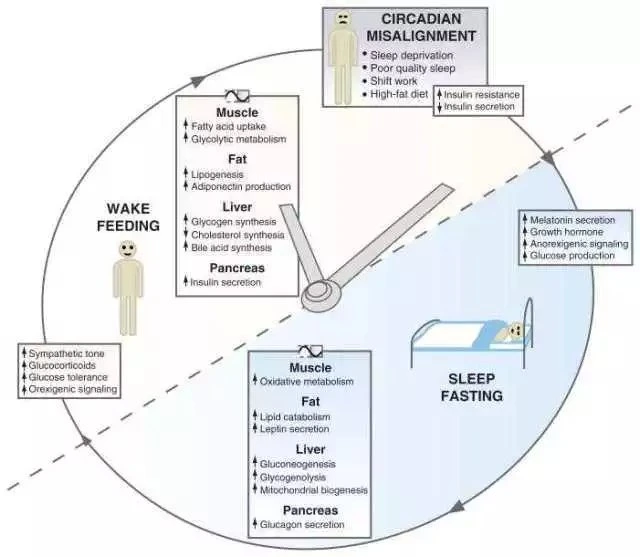
4. Circadian Lighting vs. Tunable White: Know the Difference
A common confusion in the market is between tunable white and circadian lighting.
- Tunable white adjusts colour temperature (for example, 3000K to 6500K). It is a visual feature — it makes a room look warmer or cooler.
- Circadian lighting additionally manages melanopic content and M-EDI over time. It is a biological feature.
A tunable white fixture can be part of a circadian system, but merely changing CCT is not the same as delivering healthy circadian stimulus. Genuine circadian lighting schedules M-EDI dynamically — raising melanopic stimulation in the morning and lowering it at night — which is a separate engineering task beyond CCT control.
When you plan a circadian project, ask for the M-EDI schedule, the spectral data, and the control protocol (such as DALI DT8 or DALI-2). These three answers separate a real solution from a rebranded dimmer.
5. Core Benefits of Circadian Lighting for Commercial Spaces
For offices, hospitals, schools, wellness hotels and deep-plan buildings, circadian lighting delivers measurable value:
For occupants
- Higher daytime alertness and reduced eye fatigue;
- Better sleep quality after working hours;
- Improved mood and reduced sense of isolation in windowless interiors;
- Support for shift workers whose schedules fight the natural clock.
For building owners and specifiers
- A competitive edge in WELL, LEED and BREEAM certification;
- Higher tenant and employee satisfaction in human-centric workplaces;
- A differentiated "healthy building" story for marketing and ESG reporting;
- Reduced staff turnover where wellbeing is a stated priority.
Many specifiers pair dynamic circadian panels with an H50 skylight in deep-plan offices. The artificial skylight restores the visual experience of natural sky, while circadian luminaires tune the spectral output to maintain healthy melanopic stimulation through the entire day.
6. Application Scenarios for Circadian Lighting
Circadian lighting is not a single product — it is a strategy applied across building typologies:
- Office and open-plan workstations — daylight-aligned CCT and M-EDI boost focus in morning meetings and reduce afternoon fatigue;
- Windowless rooms, basements and underground meeting rooms — where daylight never reaches, circadian systems substitute biological light cues; often combined with artificial skylight for visual relief;
- Hospitals and healthcare — supporting patients' recovery and staff alertness across shifts;
- Schools and education — studies link daylight-mimicking light to improved concentration and learning outcomes;
- Wellness hotels and spas — daytime energising light, evening calming light, and night-safe lighting for corridors and lobbies;
- Shift-work environments and 24/7 facilities — scheduled light that keeps night workers alert while protecting their recovery sleep.
In every scenario, the hardware and the control system must work together. This is where a manufacturer with in-house control integration matters.
7. Meet the Manufacturer: Luminlight LED Factory
Behind every well-specified circadian project is a manufacturer that can deliver consistent, controllable, verified hardware. Luminlight (Shenzhen Lumin Lighting) is a professional LED lighting manufacturer specialising in human-centric and architectural lighting solutions.
Who we are Luminlight is a factory-direct manufacturer of LED lighting, headquartered in Shenzhen, one of the world's largest LED manufacturing hubs. We combine in-house optical, electrical and industrial design with modern automated production lines, giving customers a single accountable partner from prototyping to large-volume delivery.
What we make Our product range spans the categories most often specified for circadian and daylight-mimicking projects:
- 45° Artificial Skylight — our simulated skylight panels (including 45-degree and circular options) recreate the look and feel of a real sky view for windowless interiors;
- DALI DT8 Tunable Circadian LED Panels — edge-lit and backlit panels with DALI DT8 colour-control, engineered for real M-EDI scheduling;
- Linear lighting and Troffer lights — architectural and recessed formats that integrate circadian control into ceiling grids;
- Smart control readiness — DALI-2, DALI DT8, Zigbee, Tuya and Casambi compatibility, so circadian schedules run on the control ecosystem your project already uses.
Why customers work with us directly
- Factory-direct pricing — you buy from the maker, not a trading intermediary;
- Customisation — custom spectra, dimensions, CCT ranges, drivers and controls;
- Consistent quality — automated production, ageing tests and incoming-material control;
- Export expertise — MOQ and EXW/FOB terms, international packaging, and responsive support for global distributors and specifiers.

When you choose Luminlight, you are not just buying a fixture — you are getting a lighting partner who understands the biology and the control logic behind circadian design.
8. How to Specify a Circadian Lighting System: A Quick Checklist
For buyers and specifiers, here is a practical checklist before you commit:
- Confirm the biological target — what M-EDI levels are needed at key times of day (morning peak, midday, evening);
- Choose a control protocol — DALI DT8 for colour-tuning, DALI-2 for scene scheduling, or wireless (Zigbee/Tuya/Casambi) for retrofit projects;
- Select the right form factor — panel, linear or troffer, plus artificial skylight for windowless visual relief;
- Request spectral data — ask the manufacturer for spectral power distribution and M-EDI / lux ratios;
- Plan the schedule — morning energising, afternoon steady, evening winding down;
- Verify certifications — check that products meet your market's standards for safety, EMC and photometric performance;
- Validate with a trial — run a pilot zone, measure occupant feedback and real M-EDI before full rollout.
Following this process protects you from buying "tunable white in disguise" and helps you build a genuinely circadian environment.
9. Frequently Asked Questions About Circadian Lighting
FAQ 1: Is human-centric lighting the same as circadian lighting?
Human-centric lighting is a broad category covering visual comfort, colour rendering and non-visual biological effects. Circadian lighting is a major subset of human-centric lighting that specifically targets circadian rhythm regulation. Artificial skylights and tunable systems both fall under the human-centric lighting umbrella.
FAQ 2: Can circadian lighting work in windowless rooms?
Yes. Windowless interiors lack natural daylight signals entirely. Circadian lighting systems — often paired with a commercial artificial skylight — recreate daylight's biological and visual cues for these spaces.
FAQ 3: Does tunable white lighting equal circadian lighting?
No. Tunable white only adjusts colour temperature. Real circadian lighting optimises melanopic M-EDI values — a separate biological metric beyond CCT adjustment — and schedules those values across the day.
FAQ 4: How do I choose a circadian lighting manufacturer?
Look for factory-direct manufacturers with in-house control integration, published spectral data, customisation capability and consistent export support. Luminlight offers DALI DT8 tunable panels, artificial skylight and linear/troffer formats, with a single accountable team from design to delivery.