
Circadian Lighting for Office: How to Boost Productivity and Alertness
Introduction: The "3 PM Slump" Is Not Just About Sleep
If you have ever worked in an open-plan office, you know the feeling. It’s 3:00 PM. Your eyelids get heavy, your focus evaporates, and you find yourself staring blankly at your screen.
Bosses often blame this on poor sleep habits or a heavy lunch. But the real culprit might be right above your head: the office lighting.
Traditional office lighting only solves one problem: "Is it bright enough?" But your brain doesn't actually care about lumens (lux). It cares about the timing and spectrum of the light. During the day, if your office environment doesn't provide enough "melanopic signal" to suppress melatonin, your brain thinks "nighttime is coming" and forces you into sleep mode.
This is why top-tier companies are upgrading to circadian lighting for offices. It’s not just about helping employees "see" better; it’s about helping them "stay awake and focused."
💡 New to Circadian Lighting?
If you are still unclear on the foundational definitions and the science of melanopic light, start with our core guide:
👉 What Is Circadian Lighting and How Does It Support Human Circadian Rhythm?
Part 1: The Science of Alertness — Why Light Matters
Why do some lights wake you up, while others make you drowsy?
As we explain in our deep-dive science article, it all comes down to ipRGCs (intrinsically photosensitive retinal ganglion cells) in the retina. When light with specific wavelengths (460-480nm blue light) enters the eye, ipRGCs send signals to the brain's master clock to suppress melatonin and promote cortisol production, keeping you alert.
In an office environment, we need to provide adequate Melanopic Equivalent Daylight Illuminance (M-EDI) specifically during daytime working hours.
💡 Want the full biological picture?
To understand the exact cellular pathway and how light impacts alertness, read our full science breakdown:
👉 Circadian Rhythm & Light: The Science Behind It
Part 2: The "Daytime Metric" for Offices
According to the globally recognized WELL Building Standard v2 (Feature L03) and lighting engineering guidelines, to maintain a highly productive workforce:
-
Daytime (9 AM to 5 PM): The M-EDI at eye level should ideally be maintained at ≥250 lx. This is the "biologically effective" light that keeps people sharp.
-
Evening: As employees leave or wind down, the system should automatically reduce M-EDI to prepare the body for sleep.
If your office is only equipped with standard 3000K warm panels or basic Tunable White (CCT tuning), they might look bright, but they are biologically ineffective for daytime alertness.
💡 Don't be fooled by basic Tunable White.
Many suppliers claim their fixtures are circadian just because they change color temperature. Learn how to tell true circadian lighting from fake ones:
👉 Tunable White vs. True Circadian Lighting: Key Differences
Part 3: How to Choose the Right Fixtures (The Lumin Product Matrix)
An office is not an art gallery. Not every area needs the most expensive, complex lighting. You need a smart combination of light. As a source factory in Shenzhen, Lumin provides a hardware matrix covering all office scenarios:
Scenario 1: Large General Workspaces — Extreme Efficacy & Low Glare
In these areas, businesses care most about electricity costs and protecting employee vision. The higher the efficacy, the faster the ROI.
-
Recommended: Lumin 150 lm/W High-Efficacy Back-lit Panel Light (LM-PZ-66-28)
-
With 28W, it delivers 4200 lumens, saving up to 50% energy compared to standard panels.
-
UGR < 19, meeting strict office standards to minimize eye strain and screen reflections.
-
Circadian capability: Supports 0-10V and DALI dimming, allowing the system to provide maximum brightness during focus hours and dim during breaks.
-

Scenario 2: Design Studios & Executive Offices — True Color & Full Spectrum
Designers reviewing artwork and executives reading documents need excellent visual color rendering (CRI) and high biological stimulation to stay sharp.
-
Recommended: Lumin PROSUN 45W 5000K Full-Spectrum Panel (LM-PL-66-45)
-
CRI Ra 97, rendering colors with sunlight-like accuracy; 5000K CCT provides excellent daytime alertness.
-
Uses a sun-like full spectrum design to meet higher melanopic stimulation needs while ensuring visual comfort.
-

Scenario 3: Open-Plan Areas & Corridors — Seamless Lines & Modern Aesthetics
Spaces that require seamless splicing and minimalist design.
-
Recommended: Lumin UltLine X2 Seamless Linear Light (7550 Series)
-
UGR19 low glare, zero flicker, CRI98.
-
Supports DALI DT8 / 1-10V dimming and perfectly integrates with the building's BMS for full-day circadian scheduling.
-

Scenario 4: Meeting Rooms & Breakout Areas — Indirect Lighting & Eye Comfort
Long meetings in rooms with only harsh direct ceiling light lead to severe eye fatigue.
-
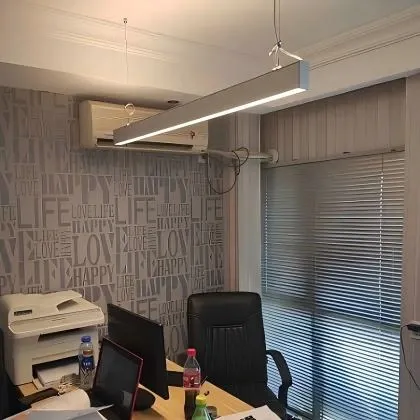
Recommended: Lumin Up & Down Luminous Linear Light
-
Features a 30% upward / 70% downward light distribution.
-
The indirect light bouncing off the ceiling greatly increases vertical illuminance, reduces screen glare, and visually lifts the ceiling height to relieve claustrophobia.
-
Part 4: How to Plan Your Office Circadian System
Buying great hardware is only half the battle. You need a control strategy:
-
Choose the Right Protocol: Select drivers supporting DALI DT8 or DALI-2 to ensure precise CCT tuning and scene scheduling.
-
Set a Schedule:
-
08:30–12:00: Cool white (5000K-6500K), high intensity, high M-EDI ("Wake Up" mode).
-
12:00–13:30: Dim to 3000K-4000K, lower intensity ("Lunch Break" mode).
-
13:30–17:30: Return to 5000K cool white to fight off the "3 PM slump."
-
After 17:30: Shift to 2700K warm white for cleaning or overtime, minimizing sleep disruption.
-
-
Integrate Sensors: Pair with Daylight Harvesting and PIR (occupancy) sensors to automatically dim or turn off lights when zones are empty, maximizing energy savings.
Conclusion: The Best Employee Perk is the Right Light
Traditional office lighting is a "cost item." Circadian lighting for offices is an investment.
It doesn't require a massive renovation. You just need to upgrade your procurement metrics from "Is it bright?" to "Efficacy, CRI, UGR, and M-EDI control." When your employees no longer rely on endless cups of coffee to survive the afternoon, your investment has already paid for itself.
Ready to specify a highly cost-effective circadian lighting scheme for your office project?
👉 Contact Lumin’s Technical Team for Project Support
Or download our full product catalog directly: Download Lumin Product Catalog
FAQ
Q1: Is circadian lighting for offices very expensive?
Not necessarily. You don't need to use the most expensive full-spectrum panels everywhere. We recommend a "hybrid approach": use high-efficacy back-lit panels (like the 150 lm/W series) for general workspaces to save costs, and deploy full-spectrum panels and smart control systems only in core areas like meeting rooms, design studios, and executive offices.
Q2: My office ceiling is quite low. Which fixture should I choose?
We recommend our back-lit panel lights (like LM-PZ-66-28 or LM-PL-66-33), which are only 30mm-32mm thick. They are perfect for recessed installation in drop ceilings or drywall ceilings and won't make the space feel oppressive.
Q3: We don't have a professional building management system (BMS). Can we still achieve circadian changes?
Yes. If integrating into a complex BMS is not feasible right now, you can procure DALI dimmable panels, or use fixtures equipped with wireless controls (like Zigbee or Tuya). This allows you to implement basic circadian changes via a mobile app or simple timers.