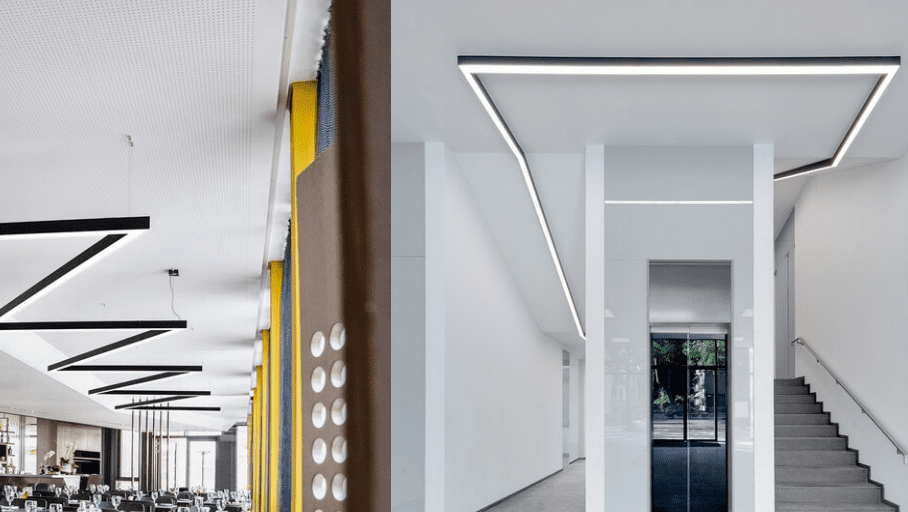
2026 LED Linear Lighting Market Trends: What Specifiers Need to Know

If you're specifying lighting for your next commercial or architectural project, you may have already noticed: linear lighting is no longer just "an option" — it's becoming the default choice.
In 2025, the global linear lighting market reached $25.87 billion and is projected to grow to $28.61 billion in 2026, representing a compound annual growth rate (CAGR) of 10.6%. By 2030, this figure is expected to reach $41.3 billion.
This is not an "emerging" market — this is a market already in high-growth phase.
Even more noteworthy are the structural forces behind this growth — five trends that are redefining the linear lighting industry and will profoundly impact every specifier, designer, and contractor's decisions. Let's break them down one by one.
1. Market Overview: Let the Data Speak
Overall Market:
| Year | Market Size | Notes |
|---|---|---|
| 2025 | $25.87 billion | Base year |
| 2026 | $28.61 billion | 10.6% CAGR |
| 2030 | $41.3 billion | 9.6% CAGR |
Source: Research and Markets, Linear Lighting Market Report 2026
Commercial LED Linear Lighting Segment:
According to QYResearch, the global commercial LED linear lighting market was valued at approximately $927 million in 2025 and is projected to reach $1.191 billion by 2032, with a CAGR of 3.7% from 2026 to 2032.
Historical growth drivers include: the transition from fluorescent to LED lighting, growth in commercial building construction, declining LED component costs, growing interest in uniform illumination, and the rise of modern interior design.
Future growth drivers include: expansion of smart building infrastructure, growing demand for flexible lighting layouts, increasingly stringent energy regulations, increased renovation of commercial spaces, and the proliferation of connected lighting control systems.
2. Five Key Trends
Trend 1: Widespread Adoption of Energy-Efficient Linear LED Lighting
Energy efficiency is no longer a "nice-to-have" — it's a basic requirement.
Globally, energy regulations are becoming increasingly stringent. From Europe's ErP Directive to the U.S. DLC certification, efficiency standards are pushing the lighting industry toward higher efficacy and lower energy consumption.
Linear LED luminaires have a natural advantage here. Compared to traditional fluorescent systems (80-90 lm/W), modern LED linear lights achieve 140-160 lm/W — 40%-75% energy savings. For a 100-luminaire commercial facility, electricity savings alone can reach $14,000-$18,000 per year.
What this means for specifiers: Specify minimum efficacy requirements (e.g., ≥130 lm/W) and prioritize products with DLC, Energy Star, or equivalent certifications.
Trend 2: Rising Demand for Architectural and Minimalist Lighting Design

Lighting is shifting from "visible luminaires" to "invisible light." Contemporary architectural language emphasizes clean lines, reduced clutter, and precise detailing.
Linear LEDs can be integrated into facades, handrails, and staircases, creating "invisible" light sources that emphasize geometry rather than the fixtures themselves. This trend is particularly evident in high-end offices, retail spaces, and public buildings.
What this means for specifiers: Choose slim, minimalist design linear luminaires with recessed mounting or seamless splicing capabilities, making lighting part of the architecture rather than an add-on.
Trend 3: Growth of Tunable White and Dynamic Lighting
Static lighting is being replaced by dynamic lighting.
Tunable White technology allows luminaires to automatically adjust color temperature throughout the day — from warm morning light (2700-3000K) to cool midday white (5000-6500K) to warm evening light — synchronizing with the human circadian rhythm.
This trend is particularly prominent in office and educational lighting. Leading brands like ERCO have already incorporated tunable white functionality into their linear products. The dimmers and dimmable lighting market is projected to grow from $19.6 billion in 2025 to $21.17 billion in 2026, at a CAGR of 8.0%.
What this means for specifiers: For office and educational projects, prioritize linear luminaires that support tunable white and DALI dimming to prepare for future human-centric lighting requirements.
Trend 4: Expansion of Smart and Connected Linear Lighting Systems
Lighting is no longer an isolated system — it's part of the smart building ecosystem.
Connected lighting control systems enable on-demand lighting, energy optimization, and predictive maintenance through sensors, IoT, and data analytics. In 2023, Signify (Philips Lighting) acquired Intelligent Lighting Controls Inc. (ILC), integrating its control technology with energy-efficient LED and linear lighting solutions to offer comprehensive smart lighting systems.
What this means for specifiers: Choose linear luminaires that support multiple protocols — DALI, 0-10V, wireless control — ensuring seamless integration with building automation platforms.

Trend 5: Growing Preference for Modular and Continuous Linear Luminaires
Designers are no longer satisfied with "a row of lights" — they want a continuous band of light.
Modular and continuous linear luminaires allow designers to create seamless light bands through seamless splicing, whether in straight lines, L-shapes, T-shapes, or grid patterns. This approach can define space, guide traffic flow, and create rhythm — making it the preferred choice for large commercial spaces.
What this means for specifiers: Choose linear lighting systems that support modular splicing and multiple layout options for maximum design flexibility.

3. How Tunable White Is Transforming Office and Educational Lighting
Tunable White is arguably the most transformative technology among the trends above — it's not just about "looking good," it's about "health and performance."
How it works: Tunable white luminaires independently control two LED channels — warm and cool — to achieve continuous color temperature adjustment from 2700K to 6500K. With time scheduling, luminaires can automatically simulate the daylight cycle from sunrise to sunset.
Impact on office environments:
-
Morning (high CCT) : Boosts alertness and cognitive performance
-
Noon (neutral CCT) : Sustains focus and productivity
-
Evening (low CCT) : Promotes relaxation and prepares for sleep
Impact on educational environments:
-
Studies show that dynamic lighting can improve student attention span and test scores
-
Tunable white can adapt to different classroom activities — exams require high CCT for alertness, while group discussions benefit from neutral CCT for a comfortable atmosphere
Leading brands like ERCO have already implemented this functionality in their linear products. As Human Centric Lighting (HCL) principles become more widely adopted, tunable white is moving from "premium option" to "standard specification."
4. Lumin UltLine X2 7550: The Perfect Solution for 2026 Market Trends
Faced with the five trends above, specifiers need a linear lighting product that addresses all of them simultaneously. The Lumin UltLine X2 7550 series is designed precisely for this purpose.
7550X Series Key Specifications:
| Parameter | Specification |
|---|---|
| Efficacy | 100-130 lm/W |
| CRI | >80 / >90 / >98 selectable |
| UGR | 14 / 19 / 22 selectable |
| CCT | 3000K / 4000K / 5000K / 6500K |
| Beam Angles | 30° / 60° / 70° / 90° / 110° |
| Control Protocols | DALI / 1-10V / Triac / Wireless |
| Mounting Methods | Suspended / Surface / Recessed / Wall / Track |
| Optical Kits | Prismatic / Opal / Louver Grill / Honeycomb |
| Warranty | 5-Year Limited |
| Lifespan | ≥50,000 hours (L80B20) |
How 7550X Addresses the Five Trends:
1. Energy-Efficient Linear LED Lighting ✅
Efficacy up to 100-130 lm/W — well above industry average. A 40W model replacing an 80W fluorescent system saves approximately 140-175 kWh per fixture annually.
2. Architectural and Minimalist Design ✅
75×50mm slim profile with 5 mounting methods for seamless integration into any architectural space. Available in white, black, and silver finishes to match different design styles.
3. Tunable White and Dynamic Lighting ✅
Supports 3000K/4000K/5000K/6500K CCT options. With DALI control, the system can achieve full dynamic color temperature adjustment throughout the day — perfectly suited for human-centric lighting applications.
4. Smart and Connected Lighting Systems ✅
Supports DALI, 1-10V, Triac, and wireless control protocols. Optional PIR sensors and microwave sensors are available, with emergency power system integration capability [UltLine X2 Datasheet].
5. Modular and Continuous Linear Luminaires ✅
Magnetic seamless connection enables perfect continuous light band splicing. Available in multiple lengths (575mm to 3151mm) with shape customization options [UltLine X2 Datasheet].
Unique Advantages of 7550X:
-
7 Optical Kit Options: Prismatic, opal diffuser, louver grill, honeycomb, and more — adapting to different glare and light distribution requirements [UltLine X2 Datasheet]
-
CCT & Wattage Selectable: Select models allow on-site CCT and wattage switching — greatly simplifying inventory management [UltLine X2 Datasheet]
-
ENEC Certified: Passed Europe's highest safety standards — quality assured [UltLine X2 Datasheet]
5. Implications for Procurement and Design Decisions
Based on the trend analysis above, here are five core recommendations for specifiers:
1. Make efficacy a core metric
Specify ≥130 lm/W in project requirements to ensure long-term energy cost control.
2. Prioritize tunable white systems
Especially in office and educational projects — tunable white is no longer a "luxury" — it's standard for healthy lighting.
3. Plan for smart integration
Choose luminaires that support DALI and wireless control to ensure future upgradeability.
4. Value modularity and design flexibility
Choose modular systems that support multiple mounting methods, multiple lengths, and multiple optical configurations for maximum design freedom.
5. Focus on total cost of ownership
Don't just look at initial purchase price — the combined value of energy savings + maintenance savings + design flexibility often far exceeds the initial price difference.
6. Conclusion
The 2026 linear lighting market is undergoing a structural transformation. A $25.87 billion market, 10.6% CAGR, and five key trends — all the data points to one conclusion: linear lighting is no longer just "a type of luminaire" — it's the core language of modern architectural lighting.
For specifiers, this means a clear choice: embrace these trends or get left behind.
The Lumin UltLine X2 7550 series is designed to address all of these trends — high efficacy, low glare, high CRI, tunable white, smart control, and modular splicing — one product that meets every requirement.
Want to learn more about the Lumin UltLine X2 7550 series specifications and application cases? Download the Lumin product catalog or contact our technical team for professional advice.
📞 Contact Us
📍 Address: F3, Building 1, Baolu Technology Park, Shiyan Street, Bao'an District, Shenzhen, Guangdong, China
📧 Email: sz@luminlight.com
📱 Phone: +86 15875556677
LED Linear Lighting ROI Analysis: A Complete Breakdown of Energy & Maintenance Savings