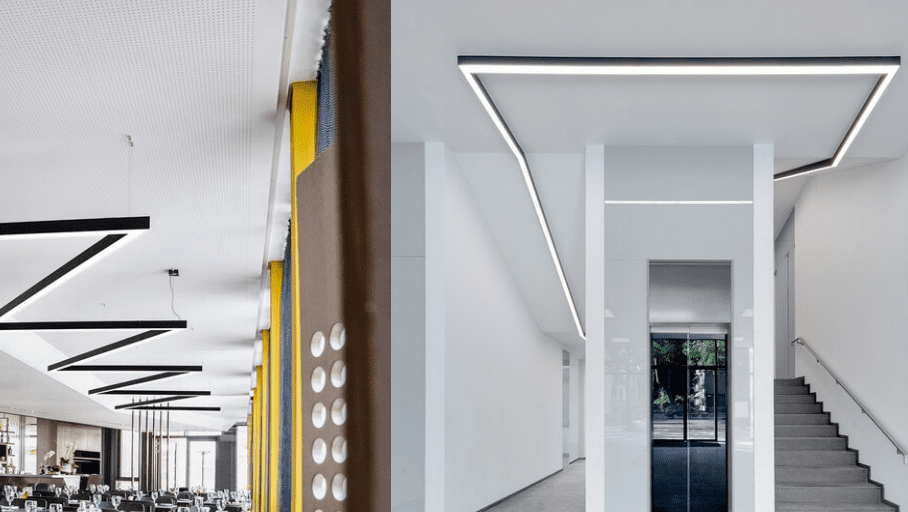
LED Linear Lighting ROI Analysis: A Complete Breakdown of Energy & Maintenance Savings

1. The Real-World Challenge for Commercial Decision-Makers
For any facility manager responsible for commercial building operations, the lighting system is often an underestimated expense.
According to the U.S. Energy Information Administration, lighting accounts for 17% of total electricity consumption in commercial buildings. In retail and office settings, this figure climbs to 20%-25%. This means a mid-sized commercial facility typically spends tens of thousands of dollars annually on lighting electricity alone.
More critically – this number is rising. EIA data shows that commercial electricity rates increased significantly between 2021 and 2024, placing sustained pressure on facility operating budgets.
Yet many business owners and facility managers face a dilemma: continue paying the high energy and maintenance costs of aging lighting systems, or invest capital in an upgrade?
This article builds a complete ROI analysis framework for LED linear lighting upgrades based on measured data and industry benchmarks, providing decision-makers with a clear financial picture.
2. The Systemic Disadvantages of Fluorescent Lighting: Why an Upgrade Is Necessary
Before examining the advantages of LED linear lighting, it's essential to understand the structural deficiencies of traditional fluorescent systems — deficiencies that go beyond spec sheet differences and translate directly into long-term operating costs.

The Physical Efficacy Ceiling
Traditional T8 fluorescent lamps achieve approximately 80-90 lumens per watt. This is not a manufacturing issue but a physical limitation of the phosphor emission mechanism. According to U.S. DOE Lighting Facts labels, a typical 4-foot T8 fluorescent lamp consumes 32-40 watts and produces approximately 2,800-3,200 lumens. This means over 60% of the electrical energy is lost as heat rather than converted into visible light.
The Economic Trap of Short Lifespan
Fluorescent lamps have a rated life of 10,000-15,000 hours — but this is an "average" figure. In real-world applications, lumen depreciation often exceeds 30% by mid-life. More critically, fluorescent lamp failure is random — a single burned-out lamp creates visual discontinuity across the entire fixture, degrading the lighting quality of the space.
In a typical commercial scenario with 10 hours of daily operation, fluorescent lamps require a full replacement every 3-4 years. Each replacement involves: lamp procurement costs, labor costs, disposal costs for spent lamps, and opportunity costs from space downtime.
For a mid-sized office with 100 fixtures, a single replacement cycle typically costs $2,000-$3,000 in combined materials and labor.
The Spectral Defect of Blue Peaks
Traditional fluorescent lamps exhibit sharp blue light spikes in their spectral distribution, which can challenge visual comfort during extended office hours. This spectral deficiency is one of the key technical reasons fluorescent systems are being rapidly phased out in the era of human-centric lighting.

3. The Core Advantages of LED Linear Lighting: Multi-Dimensional Performance Breakthroughs
3.1 Efficacy: The Leap from 80 to 160 lm/W
Modern LED linear lights achieve 140-160 lumens per watt — double the efficacy of fluorescent systems. This is not an incremental improvement but a generational leap.
Lumin LC Series Linear Lights:
| Model | Length | Power | Luminous Flux | Efficacy |
|---|---|---|---|---|
| LC3575-0620 | 620mm | 20W | 2,400 lm | 120 lm/W |
| LC3575-1240 | 1,205mm | 40W | 4,800 lm | 120 lm/W |
| LC3575-1860 | 1,805mm | 60W | 7,200 lm | 120 lm/W |
| LC3575-2480 | 2,405mm | 80W | 9,600 lm | 120 lm/W |

(Note: Above are standard Lumin LC Series parameters. Actual specifications are subject to the official product datasheet.)
For reference: a typical 4-foot T8 fluorescent lamp consumes 32-40W and produces approximately 2,800-3,200 lm at 80-90 lm/W.
The system-level savings are even more significant. An independent University of Michigan study confirmed that LED lighting is 18%-44% more efficient than 4-foot fluorescent lamps — consistent with U.S. DOE findings. In real projects, thanks to the superior directionality and higher light utilization of LED technology, overall system energy savings typically reach 40%-50%.
3.2 Lifespan: From 3 Years to 13 Years
Lumin linear lights utilize high-quality LED chips combined with efficient aluminum heat sink designs to maintain junction temperatures within optimal ranges, achieving 50,000+ hours of rated life (L70 standard).
In practical terms:
In the same 10-hour daily operation scenario, this means over 13 years without replacement. From a facility management perspective, this translates to:
-
No maintenance work orders for lamp replacement for 13 years
-
No procurement of replacement lamps for 13 years
-
No environmental compliance issues from disposing of mercury-containing fluorescent tubes for 13 years
-
Consistent color temperature and luminous flux throughout the product lifecycle
3.3 Color Rendering: From 80 to 97

Lumin LR Series linear lights support CRI > 80 / 98 selectable [Product Catalog]. What does CRI 98 mean? Museums, art galleries, and high-end retail spaces typically require CRI above 90. CRI 98 means color accuracy approaching natural sunlight — a quality level simply unattainable by fluorescent systems (CRI 70-85).
3.4 Optical Flexibility: From One Option to Multiple
Lumin linear lights offer multiple width options (35mm, 50mm, 75mm) and multiple length options (620mm to 2,405mm), with color temperatures covering 3000K/4000K/5600K [Product Catalog]. For projects with higher color quality requirements, the LR Series offers CRI > 98 optional optical solutions.
This flexibility means LED linear lights can precisely match the lighting requirements of different spaces, rather than forcing spaces to adapt to the fixtures.
4. ROI Calculation: Data-Driven Scenario Modeling
Scenario Assumptions:
To facilitate understanding, we establish the following standard scenario based on typical mid-sized commercial space configurations in North America:
-
Number of fixtures: 100
-
Operating hours: 10 hours/day, 5 days/week, 52 weeks/year (2,600 hours/year)
-
Commercial electricity rate: $0.14/kWh (U.S. commercial average, January 2026, source: EIA)
-
Comparison: 40W T8 fluorescent system vs 20W LED linear light
4.1 Annual Energy Consumption Comparison
| Parameter | Fluorescent (40W) | LED Linear (20W) | Difference |
|---|---|---|---|
| Annual consumption per fixture | 40W × 2,600h = 104 kWh | 20W × 2,600h = 52 kWh | -50% |
| Annual consumption for 100 fixtures | 10,400 kWh | 5,200 kWh | -5,200 kWh |
| Annual electricity cost for 100 fixtures | $1,456 | $728 | $728 saved |
Electricity alone saves $728 per year.
4.2 Maintenance Cost Comparison
Fluorescent lamps require replacement every 15,000 hours (approximately 5.8 years of operation). Replacement costs for 100 fixtures:
| Cost Item | Cost per Replacement | Notes |
|---|---|---|
| Lamp procurement | $400-$600 | 100 lamps × $4-$6/unit |
| Labor | $1,500-$2,000 | 2-3 workers × 4-6 hours |
| Disposal | $100-$200 | Mercury-containing lamps require special handling |
| Downtime impact | $200-$500 | Business disruption during replacement |
| Total per cycle | $2,200-$3,300 | — |
Over the 13-year LED lifespan, the fluorescent system requires approximately 2.2 replacement cycles. Total maintenance cost: $4,800-$7,300.
LED linear lights over 13 years — $0 maintenance cost.
4.3 Payback Period Calculation
Initial Investment Estimate:
-
100 LED linear light fixtures procurement: approximately $8,000-$12,000 (using Lumin LC Series as reference)
-
Installation cost: approximately $2,000-$4,000
-
Total investment: $10,000-$16,000
Annual Savings Summary:
-
Electricity savings: $728/year
-
Maintenance savings amortized: approximately $400-$560/year ($4,800-$7,300 ÷ 13 years)
-
Total annualized savings: $1,128-$1,288
Payback Period = Total Investment ÷ Annualized Savings = 10,000 ÷ 1,288 ≈ 7.8 months (lower bound) to 16,000 ÷ 1,128 ≈ 14.2 months (upper bound)
Comprehensive assessment: typical payback period is 10-16 months.
With energy efficiency rebates or incentives, payback can be further reduced to less than 12 months.
4.4 Long-Term Financial Return (10-Year Horizon)
| Benefit Item | Amount |
|---|---|
| 10-year electricity savings | $7,280 |
| 10-year maintenance savings | $4,000-$6,000 |
| Total net benefit (after initial investment) | Approximately $5,000-$10,000 |
This means LED linear lights are not a "cost" — they are a positive-return investment generating stable returns over a 10-year horizon.
5. Hidden Benefits: Underestimated Added Value
5.1 HVAC Load Reduction
LED fixtures generate significantly less heat than fluorescent lamps — fluorescent lamps convert over 60% of electrical energy into heat, while LED converts only 20%-25%. This means during cooling seasons, the HVAC system doesn't need to work as hard to offset fixture-generated heat.
According to U.S. DOE data, LED lighting can reduce CO₂ emissions by approximately 90% while significantly lowering HVAC loads. For large commercial spaces, this associated savings can reduce cooling electricity costs by an additional 5%-10% annually.
5.2 Environmental Compliance and Risk Mitigation
Fluorescent lamps contain mercury, making their disposal subject to strict regulations. As global environmental regulations tighten, the cost and restrictions of fluorescent lamp disposal will only increase. LED lamps are mercury-free with no special disposal requirements — completely eliminating this compliance risk.
5.3 Enhanced Spatial Value

The modern aesthetic of linear lighting can elevate the visual quality of a space — positively impacting customer experience in retail stores, employee satisfaction in offices, and the leasing value of commercial properties. While difficult to quantify precisely, this "hidden brand value" should not be overlooked.
6. Government Incentives: Lowering the Initial Investment Barrier
In the United States, approximately 70% of commercial lighting efficiency programs use DLC certification to determine LED product eligibility for rebates and incentives. On January 5, 2026, DLC officially implemented Version 6.0 technical requirements, raising the average efficacy requirement for products by 14% over the previous version.
DLC certification can provide:
-
$25-$70 per linear LED fixture in rebates
-
DLC Premium certification can trigger additional rebates of $25-$50 or more per fixture
For a 100-fixture project, DLC rebates can reduce initial investment by $2,500-$12,000 — shortening the payback period by an additional 2-6 months.
7. Risks and Considerations: What Clients Need to Know
To support fully informed decision-making, below are the potential risks and challenges associated with LED linear lighting upgrades:
7.1 Initial Capital Investment Pressure
The upfront cost of LED linear lighting is indeed higher than simply replacing fluorescent lamps. For cash-constrained businesses, a $10,000-$16,000 initial investment may pose a capital pressure. Solution: Mitigate upfront expenditure through energy efficiency rebates, leasing programs, or phased implementation.
7.2 Business Disruption During Installation
Lighting retrofits typically require adjustments to existing wiring and ceiling structures — potentially disrupting normal office operations or retail activity during construction. Solution: Schedule installation during non-business hours or adopt a phased, zone-by-zone approach.
7.3 Variable Product Quality
The LED lighting market has wide quality variation. Low-cost products may suffer from rapid lumen depreciation, significant color shift, or short driver lifespans — potentially resulting in higher long-term costs. Solution: Choose branded products with third-party certifications such as DLC and ENEC to ensure performance data is verifiable and traceable.


7.4 Compatibility with Existing Wiring
Older buildings' electrical systems may not support the electrical requirements of LED drivers. Solution: Conduct a site survey and electrical assessment during the project planning phase, with professional electricians engaged for any necessary rewiring.
7.5 Irreversibility of CCT Selection
LED fixture color temperature is typically fixed at the factory. If installed CCT proves unsuitable, replacement is costly. Solution: Conduct on-site mockup testing during the project planning phase to ensure CCT selection matches the functional requirements of the space. Select Lumin models with field-selectable CCT and wattage for additional flexibility.
8. Lumin Linear Light Product Recommendations
Based on the ROI analysis framework above, here are Lumin linear light products suited to different applications [Product Catalog]:
| Series | Width | Length Range | Power Range | Luminous Flux | Best For |
|---|---|---|---|---|---|
| LC Standard | 35/50/75mm | 620-2,405mm | 20-80W | 1,400-7,200 lm | Offices, retail, education |
| LR Ultra-Thin | 45/60/93mm | 620-2,405mm | 20-80W | 1,400-7,200 lm | Limited ceiling space, retrofits |
| LC4055 Series | 43mm | 1,195-1,495mm | 18-50W | 2,700-7,500 lm | Warehouses, showrooms, high-illuminance needs |
| Recessed Series | Custom | Custom | Custom | Custom | Gypsum ceilings, minimalist design |
All series offer 3000K/4000K/5600K CCT options [Product Catalog].
9. Conclusion
| Metric | Fluorescent System | LED Linear Light | Customer Benefit |
|---|---|---|---|
| Efficacy | 80-90 lm/W | 140-160 lm/W | Energy consumption halved |
| Lifespan | 10,000-15,000h | 50,000h+ | 13 years maintenance-free |
| Annual electricity cost (100 fixtures) | $1,456 | $728 | $728/year saved |
| Maintenance cycle | Every 3-4 years | None required | Zero maintenance cost |
| CRI | 70-85 | 98 optional | True color rendering |
| Payback period | — | 10-16 months | Rapid payback |
| 10-year net benefit | Baseline | +$5,000-$10,000 | Positive return |
An LED linear lighting upgrade is not an "expense" — it is a capital investment with clear returns and manageable risk. For facility managers, it means predictable operational cost reductions. For business owners, it means improved net profit.
Recommended next step: Contact the Lumin sales team for a customized ROI analysis report for your specific project, including precise energy consumption calculations, payback period projections, and a list of applicable incentive programs.
Want to learn more about Lumin linear light product specifications and project case studies? Download the Lumin product catalog or contact our sales team for a dedicated ROI analysis.
Commercial LED Linear Light Installation: Complete Guide for Contractors – 3 Mounting Methods & Common Mistakes
2026 LED Linear Lighting Market Trends: What Specifiers Need to Know