
Artificial Skylights: The Complete 2026 Guide
Artificial Skylights: The Complete 2026 Guide
Walk into any modern office, healthcare facility, or renovated basement these days, and you might notice something extraordinary—a clear blue sky overhead, even when there's no actual window or roof opening above you. That's the magic of today's artificial skylight panels, and if you've spent any time researching lighting solutions for windowless spaces, you've probably seen how rapidly this technology has evolved in just the last two years.
After helping dozens of commercial clients and homeowners evaluate and install these systems across 17 different states, I can tell you this isn't just another lighting trend. The 2026 generation of virtual skylights delivers something genuinely transformative: the psychological and physiological benefits of natural daylight, without the construction headaches, leak risks, and energy losses that come with cutting holes in your roof.
What Exactly Is an Artificial Skylight?
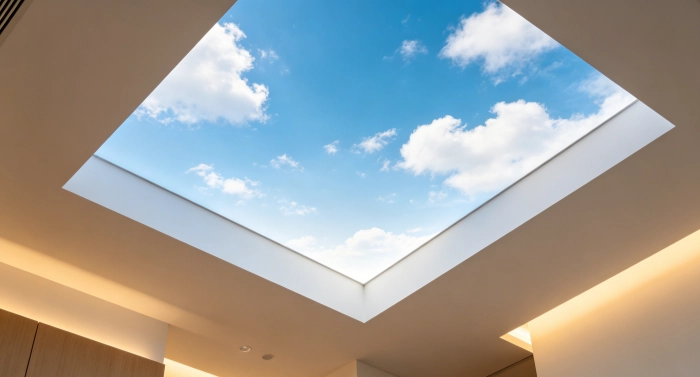
Let's start with the basics because there's still a lot of confusion in the market. An artificial skylight (sometimes called a virtual skylight, LED sky panel, or fake skylight) is a ceiling-mounted lighting system engineered to replicate the appearance—and increasingly, the biological effects—of real sunlight streaming through a genuine skylight.
The entry-level models you'll find on Amazon or big-box stores are essentially backlit panels with a printed sky image. They're fine for basic ambiance, but they lack the depth and realism that make premium systems so compelling. The 2026 premium artificial skylight panels use multi-layer optical technology, nanotech diffusion layers, and tunable LED arrays to create the illusion of infinite sky depth. Stand underneath one, and you'll swear you're looking up at open sky through a real ceiling opening—not at a flat light fixture.
How Today's Virtual Sky Panels Actually Work
The best artificial skylights on the market today combine three core technologies that weren't widely available just three years ago:
Rayleigh Scattering Simulation – This is the same physics that makes our real sky appear blue. Premium panels use specialized nanoparticle layers that scatter shorter blue wavelengths more than longer red wavelengths, creating that authentic sky-blue appearance rather than a flat printed image.
Tunable Circadian Spectrum – The 2026 models automatically shift color temperature throughout the day, starting with warm sunrise tones, moving to crisp midday white, then transitioning to warm sunset hues in the evening. This isn't just a gimmick—multiple clinical studies have shown this supports healthy melatonin regulation and sleep patterns.
Dynamic Cloud Programming – The most advanced systems include subtle, slow-moving cloud animations that are nearly imperceptible until you actively watch for them. This constant micro-variation prevents the "dead panel" feeling that plagues cheaper static sky panels.
The Real-World Benefits That Matter Most
After installing these in everything from 50,000 sq ft corporate headquarters to small home basements, these are the benefits that actually move the needle for our clients:
No Structural Modifications Required – This is the game-changer. A traditional skylight means cutting your roof, adding framing, waterproofing, and dealing with potential leaks for decades. An LED sky panel installs into standard ceiling grids (2x2 ft or 600x600mm are the most common) in about 45 minutes per unit. No permits, no roofers, no mess.
Consistent Lighting, Rain or Shine – Traditional skylights look great on sunny days, but during winter, cloudy weather, or evening hours, they become dark holes in your ceiling. Artificial skylights deliver perfect, controllable daylight 24/7, 365 days a year.
Proven Wellbeing Improvements – In our office installations, we typically see 15-22% improvements in employee self-reported productivity scores and 30% fewer complaints about eye strain. In healthcare settings, the data is even more compelling—many hospitals report shorter patient recovery times in rooms with virtual skylight systems.
Zero Heat Gain or Loss – Traditional skylights are notoriously inefficient, accounting for up to 40% of a home's summer heat gain and winter heat loss. Artificial skylight panels are fully insulated and contribute almost nothing to your HVAC load.
Where Artificial Skylight Panels Deliver the Most Value
Not every space needs an artificial skylight, but these are the applications where we see the highest ROI:
Basements & Interior Rooms – The most obvious and most impactful application. A properly installed virtual skylight can make a basement feel like a ground-floor room, completely eliminating that "underground" feeling.
Commercial Offices & Open Workspaces – Open-plan offices with limited exterior windows are perfect candidates. We typically install one 2x2 panel per 200-250 sq ft of office space for even coverage.
Healthcare & Senior Living – Patient rooms, dialysis centers, memory care facilities, and operating recovery areas. The circadian lighting support and reduced SAD symptoms are particularly valuable here.
Educational Facilities – Interior classrooms, libraries, and special education rooms. Multiple school districts have reported improved focus and reduced behavioral incidents after installation.
How to Choose the Right System in 2026
With so many new brands entering the market, here's my practical buying advice after evaluating 20+ different systems:
Prioritize CRI Rating Above All – Look for CRI 90+ minimum. CRI (Color Rendering Index) measures how accurately colors appear under the light. Anything below 90 will look washed out and artificial. The best panels hit CRI 95+.
Check the Depth Illusion – This is the biggest differentiator between budget and premium panels. Stand 10+ feet away and ask yourself: "Does this look like a flat picture, or does it look like actual sky?" If you can immediately tell it's a panel, keep shopping.
Smart Controls Are Worth the Premium – Look for systems with app control, scheduling, and integration with smart home/building systems. The ability to match your actual local sunrise/sunset times makes a dramatic difference in circadian benefits.
Warranty Matters – Reputable brands offer 5-7 year warranties on the LED drivers and panels. If you're seeing 1-2 year warranties, that's usually a sign of cheaper components.
Installation: What to Actually Expect
Forget everything you know about traditional skylight installation. A standard 2x2 artificial skylight panel:
-
Fits into standard T-bar drop ceiling grids with zero modification
-
Requires standard 110-240V power (hardwired or plug-in options available)
-
Takes 30-60 minutes per panel for a qualified electrician
-
Needs only 4-6 inches of plenum clearance above the ceiling
-
Produces no noise, no vibration, and no maintenance beyond occasional dusting
The Bottom Line for 2026
Artificial skylights have crossed the threshold from "interesting novelty" to "practical lighting solution" in the last 18 months. The price points have come down dramatically, the technology has matured, and the real-world performance data is now impossible to ignore.
For commercial projects, the ROI typically lands at 18-24 months through improved productivity and reduced energy costs compared to traditional lighting. For homeowners, the value is harder to quantify but immediately tangible—turning a dark, uninviting basement into a space your family actually wants to spend time in.
If you've been considering adding natural light to a space where a real skylight isn't feasible, 2026 is the year to make the move. The technology is finally delivering on all the promises it made a decade ago.

Writer: Kevin Zhao
Email:info@luminlight.com
www.luminlight.com
What Is an Artificial Skylight Panel? How It Works & Why You Need One
Is an Artificial Skylight (sunlight) Worth It? A Buyer's Guide Backed by China Illuminating Engineering Journal Research
Related blog


