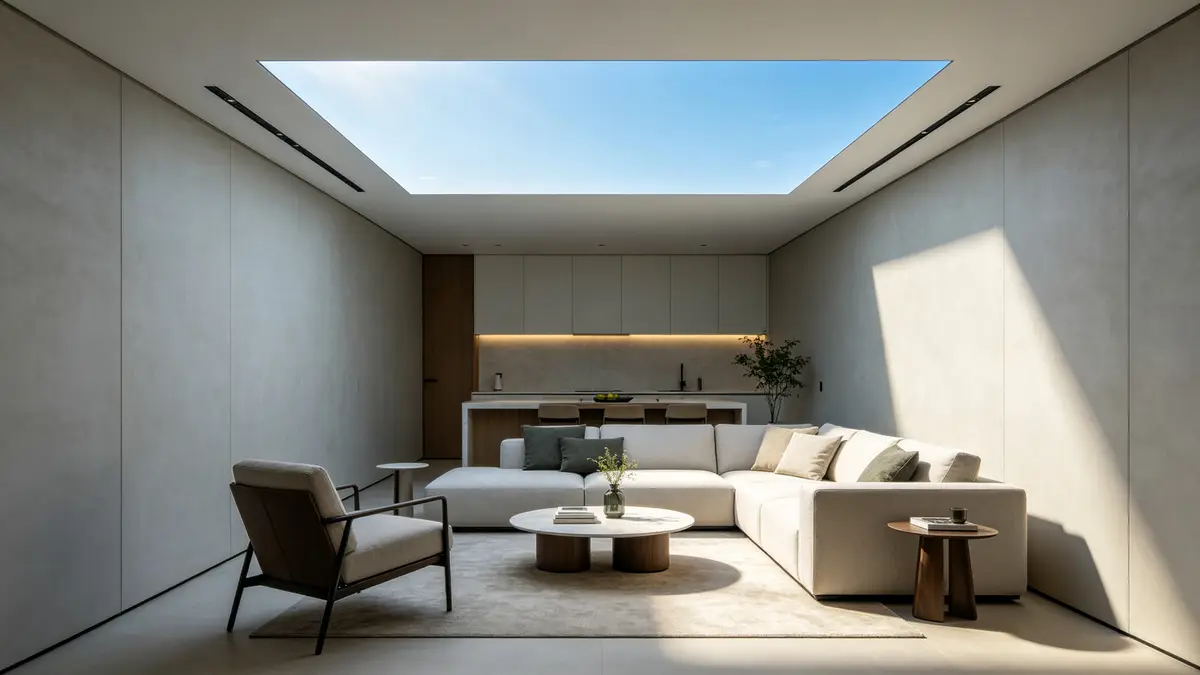
Philips Skylight vs Lumin Skylight: A 2026 Selection Guide for Commercial Projects
Introduction: The Skylight Market Enters the "Giant Competition" Era
In June 2026, Signify officially launched the Philips Skylight in Europe, starting at €499.99. This marked the first time a major international lighting brand pushed an "artificial skylight" into the mainstream consumer market.
According to a QYResearch report on the global LED smart blue sky light market, the market was valued at approximately $141 million in 2024 and is projected to reach $225 million by 2031, growing at a compound annual growth rate (CAGR) of 7.1% [1]. Demand is surging, and the question for commercial buyers is no longer "should we consider a skylight?" — it's "which skylight actually fits our project?"
This guide compares Philips Skylight and Lumin Skylight across product positioning, technical specifications, B2B suitability, and OEM flexibility — helping procurement teams, distributors, and project owners make an informed decision.
Part 1: Philips Skylight — Product Analysis
1.1 Technology Background and Positioning
Philips Skylight is built on NatureConnect LED technology, originally developed for commercial spaces like offices and hospitals. The core innovation is the "Auto Day Rhythm" function — a pre-programmed system that adjusts color temperature throughout the day without requiring an app or smart home hub. In the morning, BioUp LED emits blue-rich, high-CCT light to boost focus. In the evening, it transitions to warm tones to promote relaxation.
1.2 Core Specifications
According to reports from China Lighting Network and multiple overseas media outlets, the core specifications of Philips Skylight are as follows:
| Parameter | Specification |
|---|---|
| CCT Range | 3000K–5700K continuously adjustable |
| CRI | Ra > 90 |
| IP Rating | IP44 (suitable for bathrooms) |
| Installation | Recessed ceiling, requires ≥100mm clearance |
| Control | Remote control only — no Wi-Fi, Zigbee, or Matter |
| Sizes | Medium (650×450mm), Large (900×600mm) |
| Models | 4 variants: Skylight Medium/Large + VitaUp Medium/Large |
| Price | Starting at €499.99; VitaUp adds ~€100 |
| Luminous Flux | Medium 3800lm / Large 5300lm |
1.3 Product Highlights
-
Auto Day Rhythm: No app or hub required — pre-programmed spectral changes throughout the day
-
BioUp LED: High-CCT blue-rich light for daytime focus, warm transition for evening relaxation
-
VitaUp UV-B Module: Integrated UV-B to support vitamin D synthesis, with 8-hour auto shut-off
-
IP44 Rating: Safe for bathrooms and saunas
The core of any artificial skylight lies in the physical replication of natural light. As explained in optical research papers indexed by ScienceDirect, short-wavelength blue light scatters uniformly in atmospheric media (Rayleigh scattering) , creating the soft blue sky effect perceived by the human eye [2] — this is the core scientific principle behind all artificial skylight products. The difference between Philips and Lumin is not whether they use this principle, but how they engineer it into reality.
Part 2: Philips Skylight's B2B Limitations
Philips Skylight performs well as a consumer product. But in B2B project scenarios, three limitations become apparent.
2.1 Closed Control Ecosystem
This is the most debated point. Philips Skylight is not part of the Philips Hue ecosystem — it has no Wi-Fi, no Matter support, and no Zigbee radio. Control is entirely through the included remote — no app, no voice assistant, no wall switch compatibility.
For B2B projects, this means:
-
No integration with building automation systems (BAS)
-
No centralized multi-fixture control
-
No smart control credits for WELL/LEED certification
As Signify states in its official product documentation, the design philosophy is to "let users experience the rhythm of daylight without technological interference." But from a B2B procurement perspective, this also means it cannot integrate into the smart control architecture common in modern commercial buildings.
2.2 Higher Installation Requirements
Philips Skylight uses a recessed ceiling structure requiring at least 100mm of clearance space. Power and wiring need a dedicated circuit, and it is not compatible with standard wall switches. For retrofit projects, this means existing ceilings may need modification — adding cost and time.
2.3 Fixed Configuration, No Customization
At €499.99 per unit (plus ~€100 for VitaUp), a commercial project installing dozens or hundreds of fixtures faces substantial procurement costs. More critically, as a standardized consumer product, Philips Skylight offers fixed sizes and fixed configurations — it cannot be customized to project-specific requirements.
Part 3: Lumin Skylight — Three Product Lines for Different Needs
Lumin Lighting, a Shenzhen-based source manufacturer, offers three distinct skylight product lines. Each addresses a different B2B scenario that Philips Skylight cannot cover.
3.1 H50 Ultra-Thin Skylight Panel — The Direct Philips Competitor
The H50 is Lumin's closest product to Philips Skylight in form factor and functionality. It is a 50mm ultra-thin panel that combines tunable white light along the frame with a central blue sky.
Key advantages over Philips Skylight:
-
Wider CCT range: 2000K–10000K vs Philips' 3000K–5700K
-
Control protocol freedom: Supports DALI DT8, Zigbee, Casambi, Tuya, Wi-Fi, and Bluetooth — enabling full B2B integration
-
Thinner profile: 50mm vs Philips' ~100mm requirement
-
OEM customization: Sizes, CRI, UGR, and control protocols can be tailored
The H50 is ideal for offices, hotels, and residential projects where smart integration and a slim profile are priorities.
Internal link:

Regarding the physiological mechanisms of circadian lighting, the WELL Building Standard references CIE S 026:2018 as the metric basis for melanopic equivalent daylight illuminance (m-EDI). This international standard established the first quantitative framework for the non-visual biological effects of light, defining the non-visual impact of light on the circadian system [3] — this is exactly the design goal of the H50's tunable white function.
3.2 Blue-Shadow Series — High CRI, High Impact
The Blue-Shadow Series is Lumin's flagship commercial skylight product line. It delivers CRI Ra 95, a 2000K–8000K CCT range, and an asymmetric 45° beam angle. Power options range from 50W to 100W, with luminous flux from 2000lm to 5000lm.
Core advantages:
-
Higher CRI: Ra 95 vs Philips' Ra >90
-
Multiple sizes: 300×600mm, 600×600mm, 300×1200mm, 600×1200mm, and 140×1150mm linear format
-
Full protocol support: DALI DT8, Zigbee, Casambi, Tuya, Wi-Fi, Bluetooth, RF Remote
-
IP40 rated for indoor commercial use
The Blue-Shadow Series is designed for commercial offices, hospitals, and retail spaces where color accuracy and light quality are paramount.
Internal link:

3.3 Sun-in Series — The "Sun" Effect
The Sun-in Series adds a visible "sun" element to the blue sky. With luminous flux >20,000lm and a projection distance of up to 30 meters, it is designed for high-ceiling spaces, atriums, and large commercial areas.
Core advantages:
-
Built-in "sun" spot for enhanced realism
-
Ultra-high output: >20,000lm — far beyond Philips Skylight's 3800–5300lm
-
Long projection distance: Up to 30m
-
Suspended installation for high ceilings
For projects requiring a dramatic, immersive sky effect — hotel lobbies, shopping mall atriums, exhibition halls — the Sun-in Series delivers an experience Philips Skylight simply cannot match.
Internal link:

Part 4: Core Specification Comparison
| Dimension | Philips Skylight | Lumin H50 | Lumin Blue-Shadow | Lumin Sun-in |
|---|---|---|---|---|
| CCT Range | 3000K–5700K | 2000K–10000K | 2000K–8000K | 6500K |
| CRI | Ra >90 | Ra >90 | Ra 95 | Ra 95 |
| UGR | Not disclosed | Configurable | Asymmetric 45° | N/A |
| Control | Remote only | DALI/Zigbee/Tuya/Wi-Fi/BT | DALI/Zigbee/Tuya/Wi-Fi/BT | 0-10V/Mesh 5.0 |
| Smart Integration | ❌ None | ✅ Full ecosystem | ✅ Full ecosystem | ✅ Mesh 5.0 |
| Installation | Recessed (100mm+) | Recessed/Suspended | Recessed/Integrated | Suspended |
| Thickness | ~100mm+ | 50mm | 150–235mm | 380–680mm |
| Luminous Flux | 3800–5300lm | 4800–7600lm | 2000–5000lm | >20,000lm |
| IP Rating | IP44 | IP40 | IP40 | IP40 |
| OEM Customization | ❌ Standardized | ✅ Full OEM | ✅ Full OEM | ✅ Full OEM |
| Price | €499.99+ retail | Factory-direct | Factory-direct | Factory-direct |
| Target Market | Residential/Hotel | Commercial/Office | Commercial/Healthcare | Large Commercial |
Indoor lighting design has always sought a balance between functionality and natural simulation. Real skylights depend on building openings and weather conditions, bringing uncontrollable light intensity, glare, and water leakage risks. According to the IES RP-5-13 "Recommended Practice for Daylighting Buildings" published by the Illuminating Engineering Society (IES), traditional architectural skylights require roof structure modifications, regular waterproofing maintenance, and cannot provide stable daylight across different seasons and weather conditions [4] — this is the structural reason why artificial skylights are gaining traction in commercial projects.
Part 5: B2B Selection Logic
When to Choose Philips Skylight
-
Mid-to-high-end residential projects (single-family homes, villas)
-
Small boutique hotel projects (guest rooms, not public areas)
-
Designer-led projects where brand recognition matters
-
Small-scale installations where smart integration is not required
When to Choose Lumin Skylight
-
Large commercial projects (offices, hospitals, schools, malls)
-
Projects requiring DALI/BAS integration
-
WELL/LEED certification projects with strict CRI/UGR requirements
-
OEM/ODM needs for distributors and contractors
-
Retrofit projects needing flexible installation options
-
Budget-sensitive but quality-focused bulk procurement
Part 6: Why OEM Capability Matters for Contractors
For contractors and distributors, OEM capability is not just about cost — it's about project competitiveness.
1. Meeting Differentiated Project Requirements
Every commercial project has unique needs. One might require CRI 97 for a museum. Another might need UGR 14 for a precision workspace. Standardized products cannot cover all scenarios — OEM customization can.
2. Brand Building and Client Loyalty
Distributors can build their own brand through private-label production, accumulating brand equity and increasing client stickiness. Lumin's OEM service supports creating exclusive branded product lines — a critical differentiator in a competitive market.
3. Cost Control and Supply Chain Flexibility
Factory-direct supply from Shenzhen eliminates middlemen. Configuration can be adjusted based on order volume, helping contractors optimize within budget. Lumin's supply capacity is 1,000 units per month, with a minimum order quantity of 4 units and fast sampling support.
4. Technical Response Speed
B2B projects often require rapid sampling and delivery. As a source factory, Lumin can respond quickly to customization requests — the cycle from requirement to sample delivery is far shorter than going through brand-owner approval layers.
The CIE S 026:2018 standard, published by the International Commission on Illumination (CIE), established the first internationally recognized metric system for the non-visual biological effects of light — defining melanopic equivalent daylight illuminance (m-EDI). This standard is the basis for WELL v2's EML (Equivalent Melanopic Lux) requirement of 150 (Tier 1) or 275 (Tier 2) , and a key technical framework for evaluating the health value of artificial skylights [5].
Part 7: Conclusion
Philips Skylight's launch is a signal that the artificial skylight category is going mainstream. But as a consumer-grade standardized product, it has clear boundaries in control protocols, customization flexibility, and B2B adaptability.
For procurement teams, distributors, and large project owners, choosing between Philips and Lumin is fundamentally a question of scenario fit:
-
Mid-to-high-end residential, boutique hotel, no smart integration needed → Philips Skylight is a convenient choice
-
Large commercial, DALI integration, high CRI/low UGR, OEM customization → Lumin offers solutions Philips cannot cover
In 2026, with WELL standards becoming the norm and smart lighting a commercial project baseline, flexibility and integrability are the core selection criteria. That's exactly where Lumin's advantage as a Shenzhen source factory lies.
Ready to explore artificial skylight panels for your next project?
📥 Download the Lumin Product Catalog
📧 Contact us: info@luminlighting.com
📱 Phone: +86 15875556677
References
[1] QYResearch. Global LED Smart Blue Sky Light Market Research Report 2025.
[2] ScienceDirect. Rayleigh Scattering and Atmospheric Optics: Principles and Applications.
[5] WELL Building Institute. WELL Building Standard v2 – Feature L03: Circadian Lighting Design.
The Artificial Skylight Market Is Booming – Why Now Is the Time to Invest