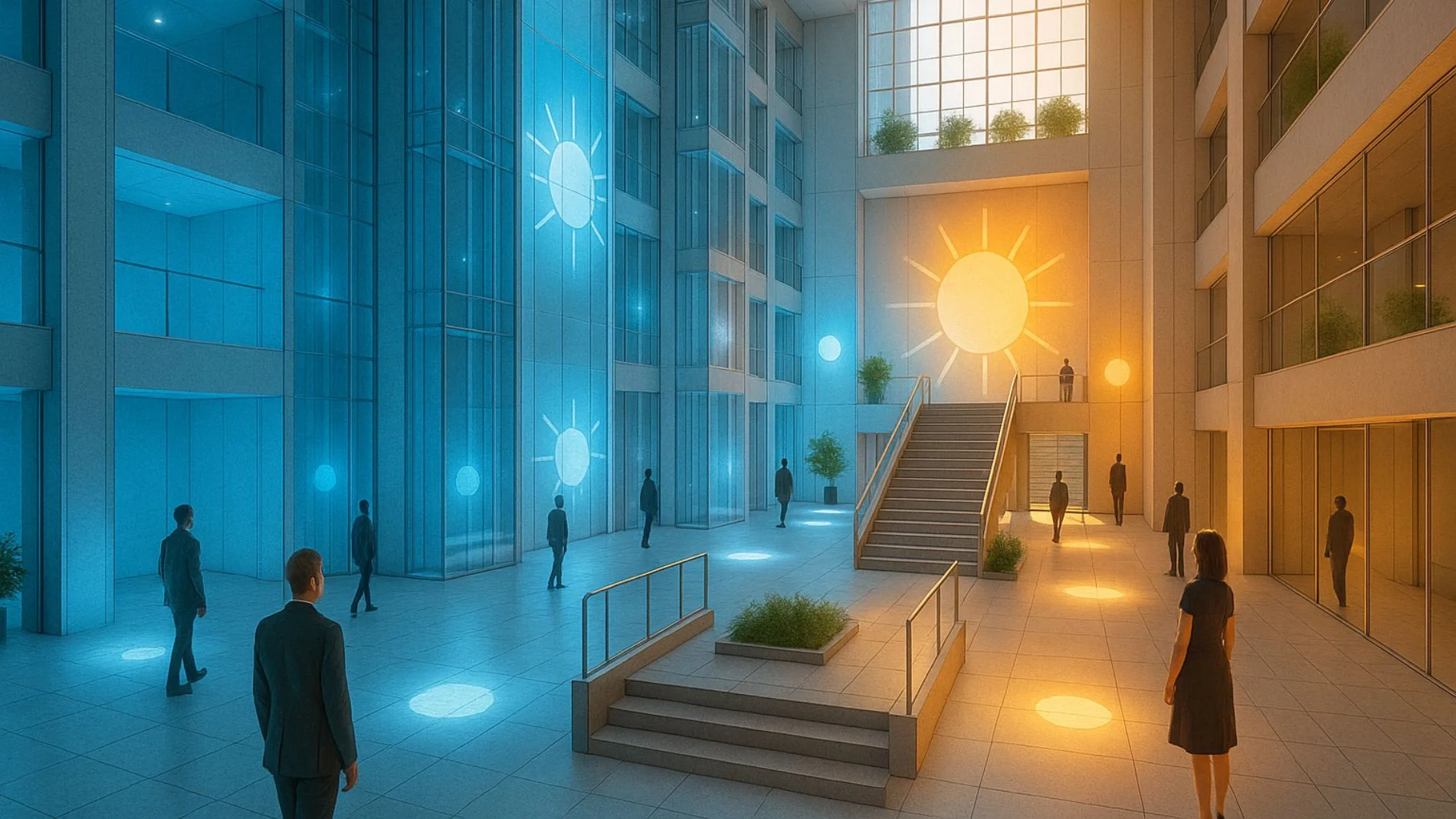
How Melanopic Light Works: M-EDI Metric Explained
Introduction: Why Lux Alone Is No Longer Enough
You measure 500 lux in an office — by any traditional lighting standard, that’s a “bright” and fully compliant workspace. Yet the people working in that space may still feel drowsy, struggle to focus, and find it hard to fall asleep at night. The problem isn’t whether the light is “bright enough” — it’s whether that light carries enough (or precisely the right amount of) melanopic signal to tell the brain what time of day it is.
This is the core of melanopic light: it describes how strongly a light source stimulates intrinsically photosensitive retinal ganglion cells (ipRGCs) , not how strongly it stimulates the visual photoreceptors. And M-EDI (Melanopic Equivalent Daylight Illuminance) turns that biological effect into a measurable, comparable engineering metric.
Have a project in mind? Not sure whether your lighting design meets the basic requirements of melanopic design? Contact us for M-EDI design guidance and product selection advice →
This article explains how melanopic light works, the mathematical definition and measurement of M-EDI, the internationally recognized recommended thresholds, and how to specify genuinely circadian-effective lighting in real projects.
Part 1: The Biology of Melanopic Light — ipRGCs and Melanopsin
1.1 The “Fifth Photoreceptor” in the Eye
For decades, science held that the human eye had only two types of photoreceptor: rods for dim vision and cones for colour and detail. That understanding was overturned in 2002, when researchers discovered intrinsically photosensitive retinal ganglion cells (ipRGCs) — cells that do not form images but respond directly to light intensity, and are particularly sensitive to short-wavelength blue light [1].
ipRGCs are “intrinsically photosensitive” because they express a photopigment called melanopsin. Melanopsin peaks at approximately 480 nanometres, squarely in the blue band [2]. When blue light strikes ipRGCs, melanopsin is activated, the cell depolarises, and the signal travels via the retinohypothalamic tract (RHT) directly to the brain’s suprachiasmatic nucleus (SCN) — the body’s “master clock” for circadian rhythm.
1.2 Why Blue Light, Not Brightness?
Melanopsin’s spectral sensitivity is no accident. In natural evolution, the solar spectrum shifts across the day: at dawn and dusk, short-wavelength blue light is relatively more prominent; at midday, longer-wavelength red light is relatively more prominent. Melanopsin’s preference for blue allows ipRGCs to distinguish “dawn/dusk” from “midday,” thereby calibrating the biological clock precisely [2].
This means a light that “looks bright” may have little effect on the biological clock. A lamp with high brightness but insufficient blue content may read very high on a lux meter yet produce weak ipRGC stimulation. Conversely, a moderate-brightness light rich in blue content can produce a significant circadian effect.
Lumin’s PROSUN Full-Spectrum Panel (LM-PL-66-45) uses a sun-like spectral design that maintains CRI 97 while rebalancing the output with an enriched red component. It supports visual comfort and, at the spectral design level, meets the basic requirement of spectral completeness for circadian lighting. View PROSUN Panel specifications →

Part 2: M-EDI — Turning a Biological Effect into a Measurable Number
2.1 The Definition of M-EDI: Using Daylight as the “Ruler”
If melanopic light is “stimulation of ipRGCs,” how do we describe it with a single number? The International Commission on Illumination (CIE) provided the answer in CIE S 026:2018: Melanopic Equivalent Daylight Illuminance (M-EDI) [3].
M-EDI is defined as the illuminance (in lux) of CIE standard daylight D65 required to produce the same melanopic irradiance as the test light source [4]. In other words, M-EDI converts any light source’s “biological stimulation strength” into “the equivalent lux of D65 daylight.” This allows designers and buyers to compare the circadian potency of different light sources on a single, unified scale.
2.2 M-EDI vs Visual Lux: A Key Analogy
| Metric | What It Measures | Analogy |
|---|---|---|
| Visual lux (photopic lux) | The brightness the human eye “sees” | The position of the volume knob |
| M-EDI | The biological stimulation of ipRGCs | The actual intensity of a specific frequency |
A light source with high visual lux but low M-EDI is like turning the volume knob all the way up but playing a frequency the human ear barely registers — it looks loud, but very little of it is actually “effective.”
2.3 The Calculation Logic of M-EDI (Simplified)
M-EDI is calculated from the light source’s spectral power distribution (SPD) . The core steps are:
-
Weight and integrate the source’s SPD against the melanopic action spectrum to obtain melanopic irradiance;
-
Divide the melanopic irradiance by the standard D65 conversion factor (Kmel,vD65=1.3262Kmel,vD65=1.3262 mW·lm⁻¹) to obtain the M-EDI value (in lx) [4].
This explains why two luminaires with identical visual lux can differ in M-EDI by several times — their SPDs differ, their blue content differs, and their efficiency at stimulating melanopsin differs accordingly.
Technical note: When evaluating a supplier’s product, ask for spectral power distribution (SPD) data and an M-EDI calculation methodology based on CIE S 026. Products that only offer CCT and CRI make it difficult to demonstrate their circadian design intent. Contact Lumin for PROSUN Panel spectral design documentation →
Part 3: Recommended M-EDI Levels — High During the Day, Low in the Evening
M-EDI is a “bidirectional” metric: it needs to be sufficiently high during the day and sufficiently low in the evening and at night. Too high or too low can both adversely affect circadian rhythm.
3.1 International Consensus: Brown et al. (2022) and SLL Recommendations
In 2022, Brown et al. published widely cited consensus recommendations in PLOS Biology, which were adopted by the Society of Light and Lighting (SLL) [5]. The core thresholds are:
| Period | Recommended M-EDI (eye level) | Purpose |
|---|---|---|
| Daytime | ≥250 lx | Sufficiently anchor the circadian clock, maintain alertness and mood |
| Evening (3 hours before bed) | <10 lx | Allow melatonin to begin rising |
| Night/sleep environment | <1 lx | Protect melatonin secretion and sleep architecture |
3.2 Corresponding Requirements in the WELL Building Standard
WELL v2 (Feature L03) uses Equivalent Melanopic Lux (EML) as its primary compliance metric, requiring a minimum of 150 EML at eye level during the day and recommending below 50 EML at the horizontal work plane in the evening [6]. Because EML and M-EDI are numerically close (approximately equal under D65 daylight), the WELL thresholds can be treated as a commercial-project baseline for M-EDI practice.
3.3 Why “Bidirectional” Matters: Evidence from Empirical Research
A 2023 study published in Communications Biology directly manipulated the melanopic irradiance of evening display light while holding brightness and colour constant. The results showed that low melanopic light shortened sleep latency, reduced evening melatonin suppression, and lowered alertness; high melanopic light produced the opposite effects — and the effects were dose-dependent [7].
This means M-EDI is not simply a “must be high during the day” metric — it is a parameter that must be dynamically managed across the time dimension. A static high-M-EDI lighting installation may actually become a health risk at night.
Product context: Lumin’s DALI DT8 tunable white panel supports full-range CCT adjustment from 2000K to 6500K and can dynamically schedule colour temperature and brightness across the day according to a preset circadian programme — maintaining a higher melanopic design target during the day and smoothly transitioning to a lower melanopic level in the evening. The product design meets the basic dynamic-control requirements of M-EDI scheduling. Learn about Lumin’s tunable white panel circadian control →
Part 4: How to Measure and Verify M-EDI
4.1 Why a Standard Lux Meter Is Not Enough
A standard illuminance meter measures only visually weighted light intensity, with a sensor response curve matched to the sensitivity of human cone cells. It completely ignores the distribution of blue content in the spectrum, and therefore cannot distinguish a “high-lux, low-melanopic” light from a “medium-lux, high-melanopic” one [8].
4.2 Methods for Measuring M-EDI
Measuring M-EDI requires spectral data. The main methods include:
-
Spectroradiometer: Directly measures the source’s SPD and then derives M-EDI using the CIE S 026 calculation framework. This is the most accurate method, suitable for laboratory and on-site verification [8].
-
Dedicated melanopic illuminance meter: Some high-end illuminance meters have a built-in melanopic weighting function and can output M-EDI readings directly.
-
Low-cost RGB sensor + model: Recent research has explored estimating M-EDI using RGB sensors combined with M-EDI prediction models (such as mDER-based models), achieving accuracy of up to ±3.3% and offering a low-cost solution for large-scale on-site monitoring [9].
4.3 Measurement Position: Eye Level, Not Desk Level
Recommended M-EDI values are typically referenced to eye level (approximately 1.2 m, seated) , because that is where light actually enters the eye and stimulates ipRGCs [5]. Horizontal desk-level illuminance (the traditional lux measurement point) can differ significantly from eye-level M-EDI, especially in spaces with indirect or wall-washing lighting.
Part 5: M-EDI and CCT — Why Colour Temperature Cannot Replace M-EDI
A common misconception is that “the higher the CCT, the stronger the melanopic stimulation.” This holds as a broad trend, but is unreliable for precise specification.
A 2025 simulation study based on a real five-channel tunable LED system explicitly concluded that correlated colour temperature (CCT) is not a reasonable predictor of photobiological potency [10]. The reason is that two light sources with the same nominal CCT may have vastly different M-EDI due to differences in phosphor formulation, blue peak position, and half-width.
Therefore, M-EDI must be measured and specified as an independent parameter and cannot be “inferred” from CCT. This is precisely the core value of the CIE S 026 standard [3].
Product context: Lumin’s UltLine X2 Linear Light (7550 series) maintains UGR19 low glare and CRI98 high colour rendering while supporting DALI, 1-10V, Triac, and wireless control, allowing scheduling of colour temperature and brightness output. Its 30%/70% direct/indirect light distribution balances vertical and horizontal illuminance, providing a hardware foundation for project-level M-EDI design management. View UltLine X2 Linear Light specifications →
Part 6: How to Specify M-EDI in a Project
For buyers, designers, and contractors, here is an actionable M-EDI specification checklist:
| Step | Action | Data to Request from Supplier |
|---|---|---|
| 1 | Define project type and time-of-day requirements | Daytime target M-EDI (e.g., ≥250 lx), evening target (<10 lx) |
| 2 | Request spectral power distribution (SPD) | Full SPD data (380–780 nm) |
| 3 | Request M-EDI or mDER data | CIE S 026-based calculation results |
| 4 | Confirm control protocol | DALI DT8 / DALI-2, supporting full-day M-EDI scheduling |
| 5 | Verify eye-level M-EDI | On-site spectral measurement or third-party test reports from the supplier |
Key reminder: If a supplier can only provide “CCT range” and “CRI” but cannot provide SPD or M-EDI calculation methodology, then that product makes it difficult to demonstrate its circadian design intent.
Need to clarify M-EDI design targets for a specific project? We can help you define the design requirements for M-EDI, UGR, CRI, and other key parameters based on your space type, certification targets, and budget, and provide spectral design documentation and circadian scheduling recommendations. Contact us for detailed technical advice →
Conclusion: M-EDI Is the “Hard Currency” of Circadian Lighting
Melanopic light describes what light actually does to the human biological clock, and M-EDI turns that effect into a measurable, comparable, and specifiable engineering metric.
-
Daytime: M-EDI ≥250 lx, anchoring rhythm and maintaining alertness [5].
-
Evening: M-EDI <10 lx, allowing melatonin to rise [5].
-
Night: M-EDI <1 lx, protecting sleep [5].
In 2026 lighting specifications, “high CRI” and “tunable CCT” are no longer enough. Truly credible circadian lighting must be able to answer a more fundamental question: at the right time, what is this light saying to the ipRGCs?
Lumin Lighting’s circadian lighting product line — including the PROSUN full-spectrum panel, the DALI DT8 tunable white panel, and the low-glare UltLine X2 linear light — is built on genuine spectral engineering. We can provide spectral design documentation, and our product designs align with M-EDI design principles, supporting dynamic circadian scheduling from day to night.
Ready to plan a circadian lighting scheme for your project? Contact Lumin for spectral design documentation and circadian lighting recommendations →
FAQ
Q1: What is the difference between M-EDI and lux? Why can’t I just look at lux?
Lux is visually weighted illuminance, measuring the brightness the human eye “sees.” M-EDI is melanopically weighted equivalent illuminance, measuring how strongly light stimulates the ipRGCs (the biological clock) [8]. Two lights with the same visual lux can differ in M-EDI by several times if their spectra differ. Circadian lighting must be evaluated on M-EDI, not lux alone.
Q2: What are the recommended M-EDI values?
According to the consensus of Brown et al. (2022) and the SLL: ≥250 lx at eye level during the day, <10 lx in the 3 hours before bed, and <1 lx in the sleep environment [5]. The WELL standard uses EML as its primary metric, requiring ≥150 EML at eye level during the day [6].
Q3: Does a high-CCT lamp always have high M-EDI?
Not necessarily. CCT is only a visual description of colour temperature and cannot precisely predict melanopic potency [10]. Two light sources with the same CCT may have different M-EDI due to different SPDs. You must ask the supplier for M-EDI or mDER calculation methodology based on CIE S 026.
Q4: How is M-EDI measured? What equipment is needed?
The most accurate method is to use a spectroradiometer to measure the source’s SPD and then calculate M-EDI according to CIE S 026 [8]. A dedicated melanopic illuminance meter can provide direct readings. Measurements should be taken at eye level (approximately 1.2 m) , not at desk level [5].
Q5: What is the difference between M-EDI and mDER?
M-EDI is an absolute quantity (in lx), representing “the equivalent lux of D65 daylight.” mDER (melanopic Daylight Efficacy Ratio) is a ratio, representing the ratio of a source’s M-EDI to its visual lux, reflecting the source’s “biological efficiency” [4]. mDER does not change with brightness and is useful for quickly comparing the circadian potential of different light sources.
Human-Centric Lighting vs Circadian Lighting: What's the Difference?