
How to Choose the Right Artificial Skylight for Your Project: A 5-Step Buyer‘s Guide
You've been impressed by the visual effect of artificial skylights — that deep blue sky, that angled "sunlight" — it's truly captivating.
But when it comes time to actually place an order, questions start popping up:
-
"My dark bathroom is only 3 square meters — what size should I get?"
-
"Direct-light, wallwasher, ultra-thin — what's the difference?"
-
"What's the difference between 50W and 100W? Is brighter always better?"
-
"The supplier says their product is 'healthy lighting' — how do I verify that?"
Without clear answers, a thousand-dollar fixture might not fit, might not illuminate properly, or might not deliver the effect you imagined.
This article doesn't start with "what is an artificial skylight." Instead, we approach it from a procurement decision perspective, providing a systematic 5-step selection framework, along with key parameter explanations, common pitfalls, a supplier evaluation checklist, and Lumin's full product specifications. Whether you're a project procurement manager, distributor, designer, or property owner, this article will help you pinpoint the perfect product for your project.
Step 1: Determine Installation Space and Size
Unlike standard ceiling lights, artificial skylights aren't "one size fits all." Their dimensions directly determine the visual area of the blue sky and installation feasibility. Different spaces require different sizes. Below are specific recommendations based on Lumin's product line.
1.1 Space Type and Recommended Size
| Space Type | Area | Recommended Size | Recommended Series |
|---|---|---|---|
| Dark bathroom/kitchen | 3-6㎡ | 300×600mm | H50 TS3060, Blue-Shadow BSF3060 |
| Hallway/entryway | Narrow, long | 140×1150mm or 300×1200mm | Blue-Shadow BSF14115, H50 TS30120 |
| Study/reading nook | 6-12㎡ | 600×600mm | H50 TS6060, Blue-Shadow BSF6060 |
| Basement/small office | 10-20㎡ | 600×600mm or 600×1200mm | H50 TS60120, Blue-Shadow BSF60120 |
| Lobby/showroom/high-ceiling | 20㎡+ | Ø600-1200mm or large square | Sun-in R300/R600, Sun-in 600×600/940×1240 |
| Hospital/clinic/light therapy | — | 595×595mm, 1195×295mm, etc. | Frame Series LM-PL66, Frameless Series LM-PW66A |
| Circular design needs | — | Ø400-1200mm | Circle Series LM-P400 to LM-P1200 |
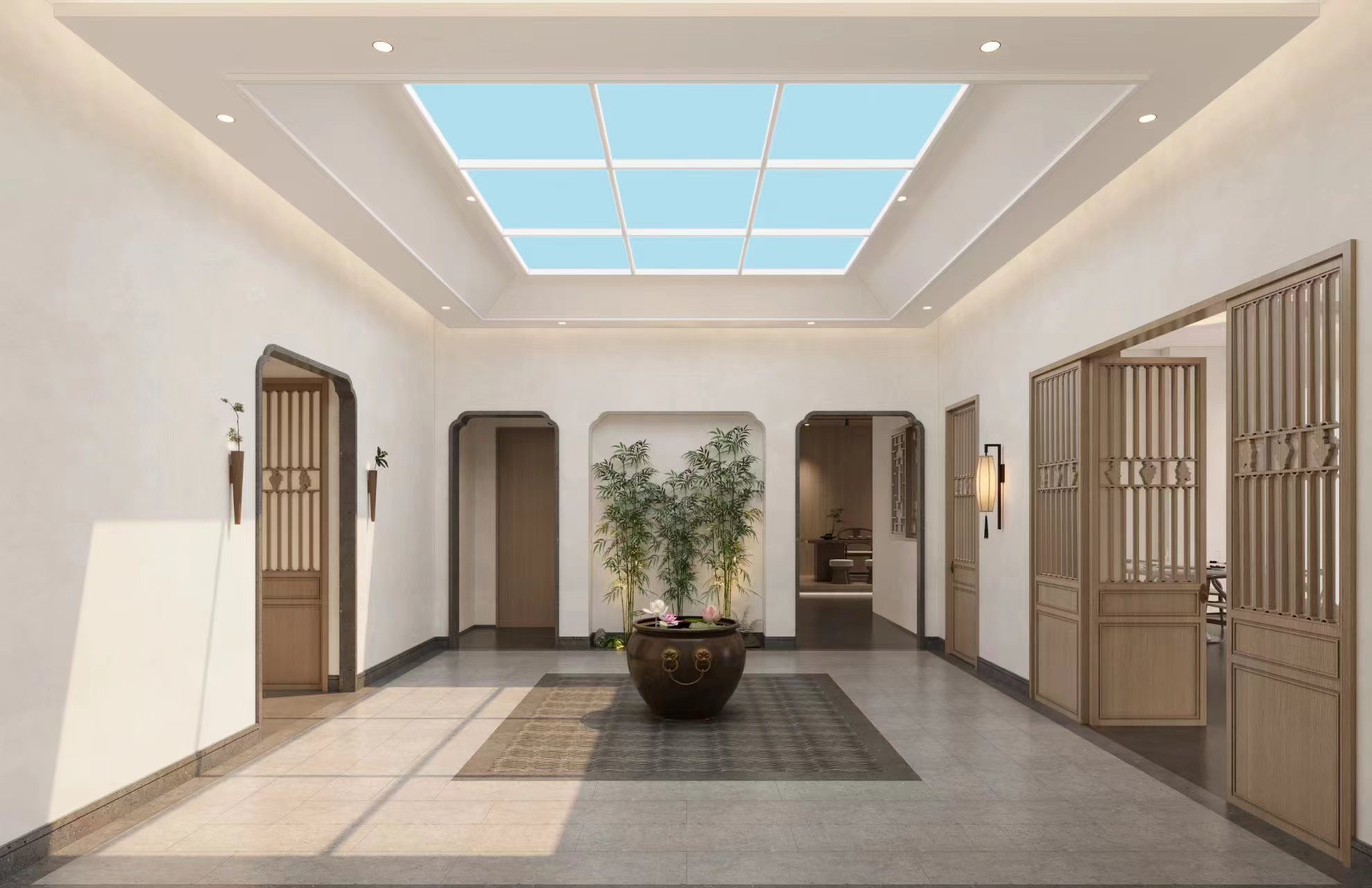
1.2 Ceiling Type and Installation Feasibility
-
Integrated ceiling (aluminum panels) : 300×600mm or 600×600mm sizes can directly replace one panel — easiest installation.
-
Gypsum board ceiling : Almost all sizes support recessed installation, but the cutout must be planned during the ceiling construction phase.
-
No dropped ceiling (concrete slab) : You can only choose suspended installation models, such as the Sun-in Series and H50 Series (suspended option).
1.3 Ceiling Clearance Check
Different series vary greatly in thickness: H50 Series is only 50mm thick, Blue-Shadow Series ranges from 112-235mm, and Sun-in Series reaches 380-680mm. Before installation, be sure to measure your ceiling clearance to ensure it can accommodate the selected model.
Not sure if your ceiling can support an installation? Get Lumin's Installation Feasibility Checklist →
Step 2: Choose the Light Type
The light type determines light direction, spatial ambiance, and visual layering. Lumin currently offers six main light types, covering everything from residential to commercial applications.
| Light Type | Representative Series | Light Characteristics | Best For |
|---|---|---|---|
| Direct-Light | Blue-Shadow BSF Series | Vertical downward, high luminous flux, wide coverage | Basements, offices, commercial spaces |
| Wallwasher | Blue-Shadow BSF14115, etc. | Asymmetric 45° angled projection onto walls, graded shadows | Hallways, entryways, dark bathrooms |
| Ultra-Thin | H50 TS/TSD Series | 50mm ultra-thin, tunable white border + central blue sky, 110° beam angle | Limited ceiling height, integrated ceilings |
| Sun-Type | Sun-in R/Square Series | Built-in "sun" spot, >20,000lm, projection >30m | High-ceiling spaces, lobbies, showrooms |
| Circular | Circle LM-P Series | Circular design, elegant and soft, surface/suspended mounting | Hospitals, clinics, rest rooms |
| Light Therapy Panel | Frame/Frameless Series | Ultra-thin 10-18mm, UV-printed patterns, spliceable | Hospitals, clinics, nursing homes, offices |
How to choose?
-
Want maximum lighting area and the most direct "skylight" feel → Choose Blue-Shadow Direct-Light
-
Want wall layering and stronger ambiance → Choose Blue-Shadow Wallwasher
-
Limited ceiling space but still want a sky light → Choose H50 Ultra-Thin Series
-
High-ceiling space with a "sun" visual element → Choose Sun-in Series
-
Need circular design or medical light therapy use → Choose Circle Series or Frame/Frameless Light Therapy Panels
Step 3: Confirm Power and Luminous Flux
Power (W) and luminous flux (lm) determine brightness and coverage capability. But there's a common procurement misconception — higher power isn't always better.
3.1 Power and Space Matching Principle
| Space Area | Recommended Power | Recommended Luminous Flux | Example Models |
|---|---|---|---|
| 3-6㎡ (dark bath/kitchen) | 40-60W | >2,000-4,800lm | H50 TS3060 (60W, 4800lm) or Blue-Shadow BSF3060 (50W, 2000lm) |
| 6-12㎡ (study/small office) | 60-70W | >3,000-4,800lm | H50 TS6060 (60W, 4800lm) or Blue-Shadow BSF6060 (70W, 3000lm) |
| 12-20㎡ (basement/meeting room) | 100-120W | >5,000-7,600lm | H50 TS60120 (120W, 7600lm) or Blue-Shadow BSF60120 (100W, 5000lm) |
| 20㎡+ (lobby/showroom) | 500-600W | >20,000lm | Sun-in R300/R600 (500W/600W, >20,000lm) |
Important reminder: Artificial skylights are more for ambient and health lighting, not primary illumination. Don't expect one sky light to light up an entire large space — larger spaces need additional fixtures for ambient lighting. If you need high-illuminance primary lighting, consider Lumin's linear lights or panel lights.
Step 4: Choose the Control Method
Smart control isn't just a "nice-to-have" — it's the core of rhythm lighting and scene switching. Lumin's full range supports multiple control protocols; different projects should choose different control methods.
| Control Method | Features | Best For |
|---|---|---|
| DALI DT8 | Wired, standardized, strong interoperability | Commercial projects, offices, hotels |
| Zigbee | Wireless, low-power, rich ecosystem | Smart homes, small-medium commercial |
| Tuya | Fast development, unified app, open ecosystem | Smart homes, rapid deployment |
| Casambi | No rewiring needed, Bluetooth Mesh | Retrofit projects, spaces where rewiring is impossible |
| Wi-Fi | No gateway needed, direct router connection | Single-fixture home control |
| Bluetooth/RF Remote | Simple, direct, no app required | Users who prefer simplicity |
Procurement advice:
-
Home use: First choice — Zigbee or Tuya — rich ecosystems that integrate with smart speakers and home systems.
-
Commercial use: First choice — DALI DT8 — professional, stable, scalable, ready for future building automation integration. According to WELL Building Standard v2, the circadian lighting credit requires lighting systems that support dimming and color tuning; DALI DT8 is an ideal choice to meet this requirement [1].
-
Retrofit projects: First choice — Casambi — no rewiring, easiest installation.
Learn about Lumin More Artificial Skylight Series mart control options →
Step 5: Confirm the Installation Method
Different ceiling types require different installation methods; this must be confirmed before procurement.
| Ceiling Type | Installation Method | Suitable Series |
|---|---|---|
| Gypsum board | Recessed | Blue-Shadow, H50, Frame Series |
| Integrated ceiling (aluminum panels) | Integrated (replace one panel) | Blue-Shadow BSF3060/BSF6060, H50 TS3060/TS6060 |
| Concrete slab (no dropped ceiling) | Suspended/Surface | Sun-in Series, H50 (suspended), Circle Series |
| Any ceiling | Surface mounted | Frameless Series, Circle Series |

- Blue-Shadow offers recessed installation with precise cutout dimensions (e.g., 285×585mm, 585×585mm), which must be planned during the ceiling construction phase.

- H50 supports recessed , surface and suspended mounting, with a profile of only 52mm — minimal ceiling clearance required.

- Sun-in is suspended by 4 suspension wires, ideal for high ceilings.
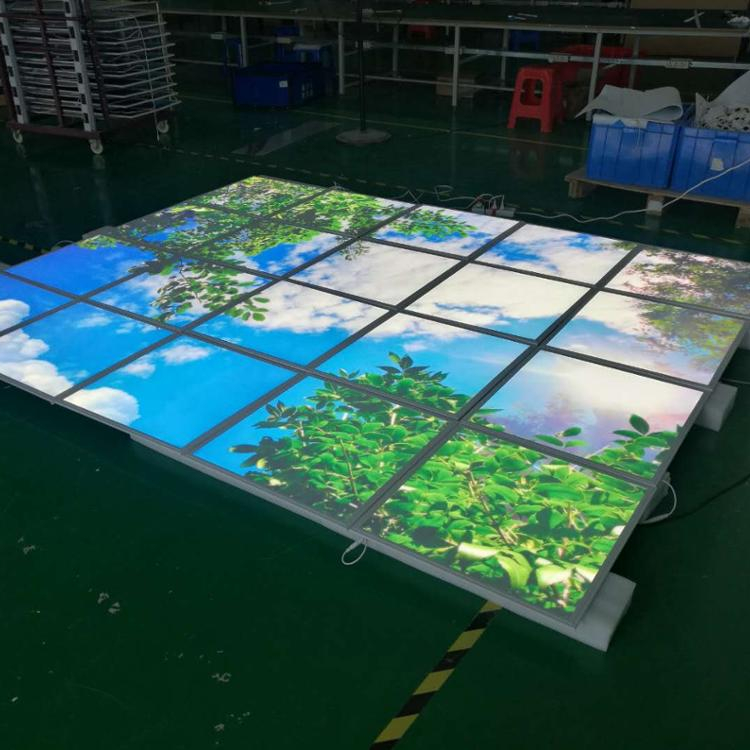

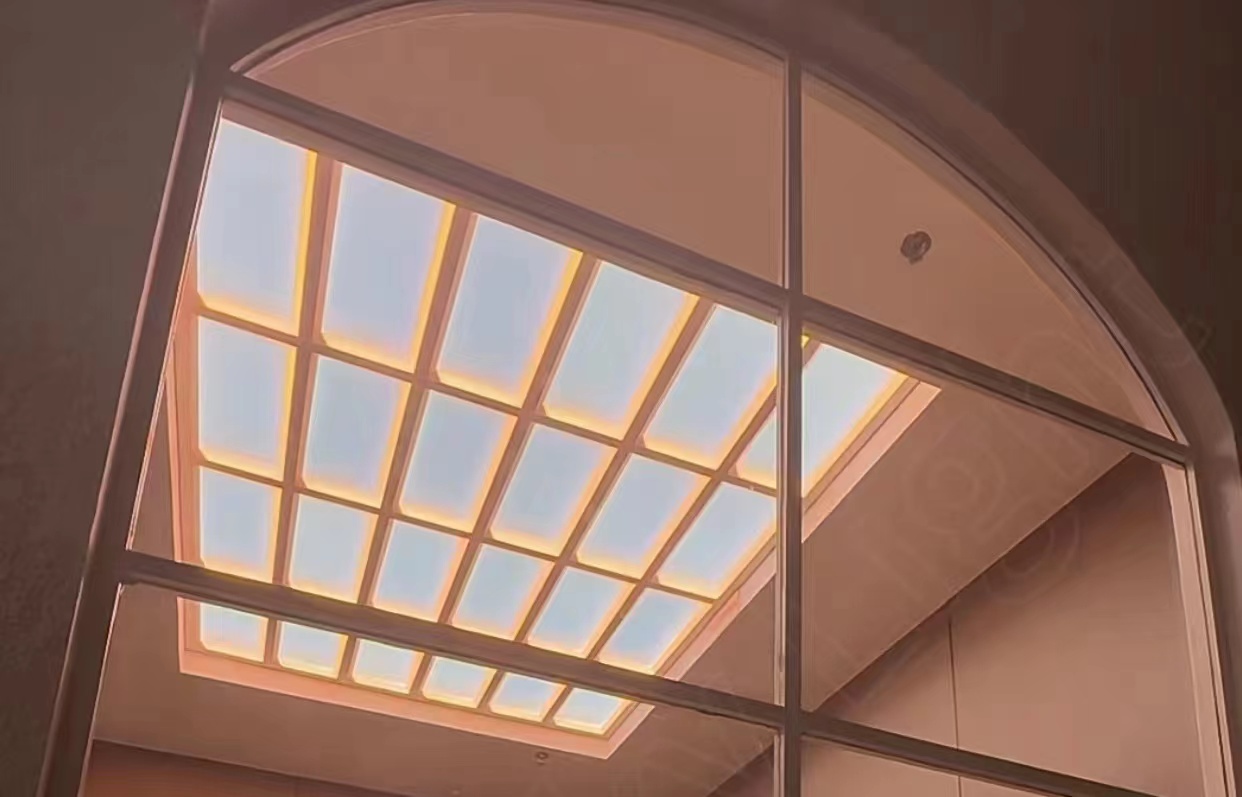
- Frame/Frameless Series support recessed ,surface and suspended mounting; Frame Series has a border design, while Frameless Series is borderless for seamless splicing.
Key Parameters Explained
When selecting an artificial skylight, you'll encounter several technical parameters. Here's a concise explanation and how to verify them during procurement.
-
CRI (Color Rendering Index)
Measures how accurately a light source renders object colors. Perfect score is 100. Lumin products achieve CRI≥93-95Ra, with some models reaching 98. Museums, art galleries, and high-end retail stores require CRI≥90. This means Lumin's CRI≥93 is higher than most household fixtures — skin tones, clothing colors, and food colors look closer to their true appearance under natural light [2].
-
CCT (Correlated Color Temperature)
The "warmth" or "coolness" of light, measured in Kelvin (K). Lumin products cover 2000K-10000K:
-
2000-2700K: Warm yellow (sunrise/sunset/candlelight)
-
3000-4000K: Warm white (evening/home)
-
5000-6500K: Cool white (noon/office)
-
6500K+: Very cool white (overcast sky)
-
Beam Angle
The spread of the light beam. Direct-light models have wider beam angles for broad coverage; wallwasher models project at a 40°-45° angle for wall-washing effects. H50 Series has a 110° wide beam, suitable for uniform illumination.
-
IP Rating
Dust and water resistance. Lumin artificial skylights are rated IP40 (indoor use) or IP20 — they are not suitable for wet or outdoor environments. In bathrooms, avoid installing directly above the shower area. For wet locations, Lumin offers an IP65 waterproof series (custom order).
-
UGR (Unified Glare Rating)
A metric for glare. According to WELL Building Standard v2, office tasks recommend UGR≤19 [3]. Some Lumin series offer UGR 14/19/22 selectable optical kits to meet different anti-glare requirements.
Common Procurement Pitfalls
Pitfall 1: "Brighter is always better"
Higher wattage ≠ better. A high-power sky light in a small space will be glaring and waste money. The key is matching — 40W is enough for a 3㎡ dark bathroom, while a 20㎡ lobby needs 300W+.
Pitfall 2: "Price is the only thing that matters"
Sky light prices range from a few hundred to several thousand dollars. The differences often lie in: scattering plate quality (affects blue sky realism), color rendering (affects color accuracy), control stability (affects user experience), and craftsmanship (affects lifespan and safety). Low-priced products often cut corners in these critical areas — dull skies, flickering lights, and severe lumen depreciation after just two years.
Pitfall 3: "A sky light can serve as the main light source"
Sky lights are more about ambient and health lighting, not primary illumination. Larger spaces need additional fixtures for ambient lighting.
Pitfall 4: "All sky lights are the same"
Optical design, spectral quality, and blue sky realism vary greatly across brands and series. Lumin is built on Rayleigh scattering technology with nano-PMMA light guide plates and OSRAM LEDs, delivering a deep, natural blue sky [4].
Want to verify supplier sample quality? Request a free Lumin sample test →
Lumin Product Lineup at a Glance
| Series | Key Features | Best For | Power Range | Luminous Flux |
|---|---|---|---|---|
| Ultra-Thin PT | Only 50mm thick, integrated ceiling specific | Dark baths, dark kitchens, limited ceiling height | 40W | >2,500lm |
| Ultra-Thin PL | Ceiling-mounted, four sky modules | Living rooms, studies, large spaces | 160W | >10,000lm |
| Direct-Light E | Vertical down, high luminous flux | Basements, offices, commercial spaces | 150-300W | >5,000-10,000lm |
| Wallwasher D | 40°-45° wall projection, strong layering | Hallways, entryways, dark bathrooms | 25-150W | >1,000-6,000lm |
| Sun-Type T | Built-in “sun” spot, ultra-high brightness | Lobbies, showrooms, high-ceiling spaces | 500-600W | >20,000lm |
| Linear L | Narrow, long design, recessed into ceiling | Hallways, corridors | 50W | >2,000lm |
Summary: 5-Step Selection Checklist
| Step | Core Question | Key Decision Points |
|---|---|---|
| Step 1 | Where will it go? How large is the space? | Space size determines dimensions and power |
| Step 2 | What lighting effect do you want? | Direct/Wallwasher/Ultra-Thin/Sun-Type |
| Step 3 | How bright does it need to be? | Match power and luminous flux to space area |
| Step 4 | How will you control it? | Home = Zigbee/Tuya; Commercial = DALI |
| Step 5 | Can your ceiling support it? | Ceiling type determines installation method |
FAQ
Q1: What's the difference between an artificial skylight and a regular LED panel light?
A regular LED panel light only provides illumination, while an artificial skylight uses Rayleigh scattering technology to simulate a blue sky effect and also delivers healthy lighting value. The core difference: artificial skylights have a scientific spectral design that provides a visual experience close to natural light, while regular panel lights do not.
Q2: As a procurement manager, how do I judge whether a sky light supplier is reliable?
Five key checkpoints: ① Do they provide spectral test reports? ② Do their control protocols cover mainstream standards like DALI/Zigbee/Tuya? ③ Do they have CE, RoHS, ENEC certifications? ④ Do they support OEM/ODM customization? ⑤ Are their monthly capacity and delivery lead times stable?
Q3: What is the profit margin for the sky light category?
According to industry data, gross margins for sky lights are typically 15%-30% higher than regular LED lighting products.
Reasons: ① The category is relatively new, and price competition has not yet intensified; ② Technical barriers are higher, making it difficult for low-quality products to imitate a true blue sky effect; ③ The healthy lighting concept creates brand premium space.
Q4: What customization options does Lumin offer for sky lights?
Lumin supports size customization (300×600mm to 1200×600mm and non-standard sizes), CRI customization (Ra>80/>90/>95 optional), control protocol customization (DALI DT8/Zigbee/Tuya/Casambi/Wi-Fi/Bluetooth), CCT customization (2000K-10000K), and private labeling.
Q5: If my project needs light therapy functionality, which series should I choose?
If the project is a hospital, clinic, nursing home, or a space requiring light therapy support, we recommend the Frame Series or Frameless Series light therapy panels. Both series use UV-printed patterns to simulate natural scenes like blue sky, white clouds, forests, and flowers, helping to relieve stress and improve mood. The Frame Series has a border design for easy installation; the Frameless Series is borderless for seamless splicing and a cleaner visual effect.
An artificial skylight isn't just another light fixture. It's a light environment management system, a health lighting tool, and a design element that enhances spatial quality.
Whether you're a project procurement manager, distributor, designer, or property owner, the core logic for choosing an artificial skylight is: match requirements, verify parameters, validate quality, confirm supply.
Want to learn more about detailed specifications and installation requirements for Lumin's full range? Download the full Lumin product catalog or contact our sales team for one-on-one selection advice.
Looking for a reliable artificial skylight supplier for your next project? Get a Lumin OEM Customization Quote →
Explore Commercial Artificial Skylight Panels Looking for realistic, glare-free sky lighting for your office, healthcare space or windowless interior? Our factory-direct artificial skylight panels deliver true Rayleigh scattering effects with a 5-year warranty and full OEM/ODM support.
References
[1] WELL Building Institute. WELL Building Standard v2 – Feature L03: Circadian Lighting Design.
[2] Wikipedia. Color rendering index.
[4] ScienceDirect. Rayleigh scattering and atmospheric optics: principles and applications.
[6] Mayo Clinic. Seasonal affective disorder: Light therapy as an effective treatment.
[7] QYResearch. LED Smart Blue Sky Light – Global Market Report 2025.
[8] Wikipedia. Circadian rhythm.
📍 Address: F3, Building 1, Baolu Technology Park, No.108, Baoshi West Road, Shiyan St., Bao'an Dist., Shenzhen, Guangdong, China
📧 Email: info@luminlighting.com
📱 Phone: +86 15875556677
The Artificial Skylight Market Is Booming – Why Now Is the Time to Invest
Smart Control for Artificial Skylights: DALI, Zigbee, Tuya, and Beyond – Complete Protocol Guide


