
What Is Rayleigh Scattering and How Does It Create a Realistic Artificial Skylight?

Have you ever looked up at a blue sky light and wondered: how does this fixture actually put a “blue sky” into the ceiling?
It’s not a piece of blue glass. It‘s not a blue sticker. That deep blue hue you see is backed by a complete physical principle – Rayleigh scattering.
Today, we’ll start with the physics of Rayleigh scattering, explore why the sky is blue, and see how this phenomenon has been “packaged” into a light fixture.
1. What Is Rayleigh Scattering, and Why Is the Sky Blue?
This might be one of the most fundamental curiosities of childhood. The answer is: because of Rayleigh scattering.
Rayleigh scattering – named after the British physicist Lord Rayleigh – describes a physical phenomenon where light scatters in all directions when it passes through a medium containing particles much smaller than the light‘s wavelength (typically less than one-tenth of the wavelength) .
When sunlight enters Earth‘s atmosphere, it encounters nitrogen and oxygen molecules. These molecules are far smaller than the wavelength of visible light – and that‘s when Rayleigh scattering happens.
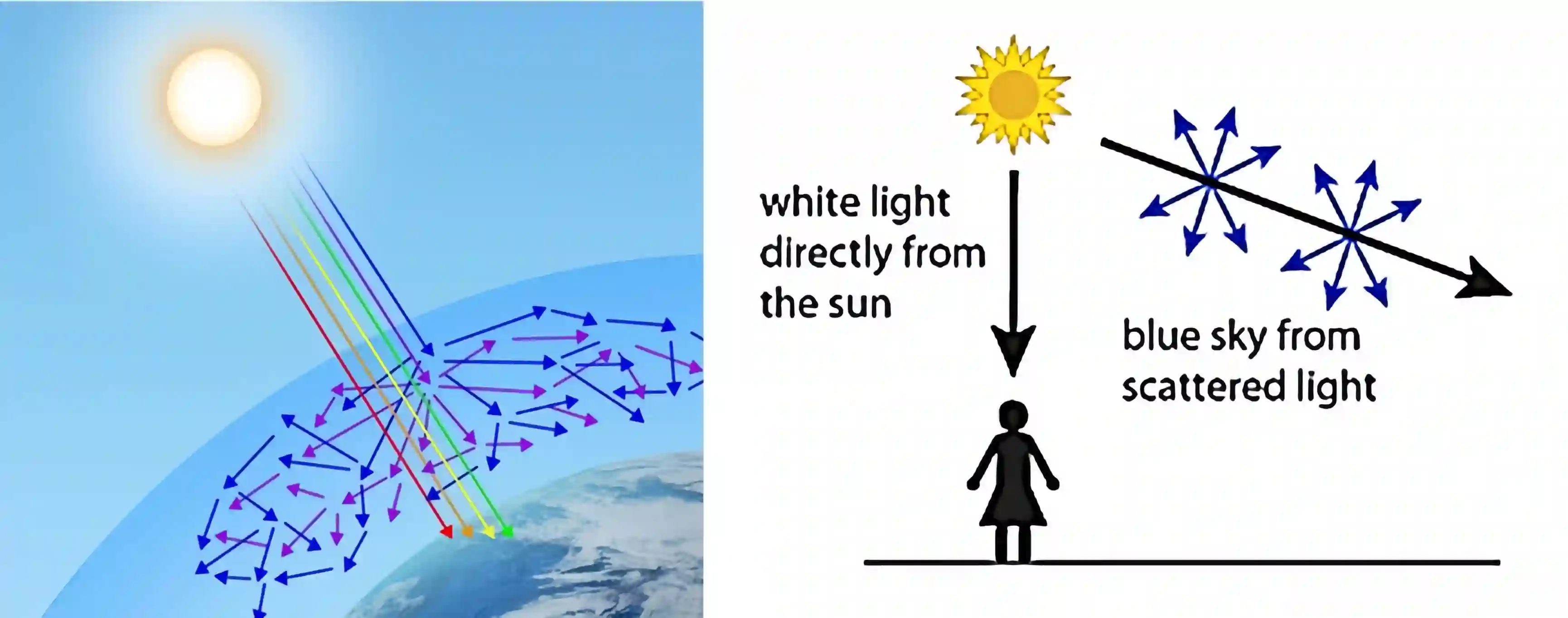
Here’s the key: the intensity of Rayleigh scattering is inversely proportional to the fourth power of the light‘s wavelength. In other words – the shorter the wavelength, the more strongly it scatters.
Among visible light, blue and violet have the shortest wavelengths, so they scatter most intensely. While violet scatters even more, the sun emits less violet light in its spectrum, and our eyes are less sensitive to it. So what we see is blue light scattered across the entire sky – giving us that familiar blue canopy.

Why does the sky turn red at sunrise and sunset? Same principle. At these times, sunlight enters the atmosphere at a low angle, traveling a much longer path through the air than during the day. By the time it reaches our eyes, most of the blue light has been scattered away. The longer red wavelengths, which scatter less, travel through with minimal loss – and the sky takes on those warm orange-red tones.

2. How Does an Artificial Skylight “Replicate” Rayleigh Scattering?
Once you understand Rayleigh scattering, the logic behind artificial skylights becomes clear.
In nature, the “medium” for Rayleigh scattering is Earth‘s atmosphere – about 6 miles (10 km) of air molecules.
In an artificial skylight, engineers have “compressed” this process into a plate just a few millimeters thick.
How? The core is a nano-scattering plate.
The “blue sky” you see when you look up isn‘t painted on – it’s light being scattered. The principle is exactly the same as when you look up at the sky outdoors. This optical technology is applied across our full range of LED artificial skylight panels, delivering realistic blue sky effects without external windows.
3. Lumin‘s Technical Implementation
Lumin‘s artificial skylight products are engineered around this very principle. Three core technologies make it work:
3.1 Nano PMMA Light Guide Plate
Lumin sky lights use optical-grade PMMA nano light guide plates. This material incorporates nano-scale scattering particles uniformly into the PMMA substrate, efficiently converting point or line light sources into a uniform surface light source-. It serves two essential functions:
-
Rayleigh scattering: Nano-particles preferentially scatter blue light, creating the visual effect of a blue sky
-
Uniform light guiding: Ensures consistent brightness and color across the entire light-emitting surface, eliminating hotspots or dark areas


Lumin‘s full range of sky lights is powered by OSRAM LEDs, delivering high efficacy and low optical decay with a lifespan exceeding 30,000 hours. More importantly, OSRAM LEDs offer a wide color temperature range from 2000K warm white to 10000K cool white – which, when combined with the Rayleigh scattering plate, allows simulation of daylight effects from early morning to high noon.
3.3 Rhythm Lighting and Smart Control
Lumin sky lights support Rhythm Lighting – via the app, the light automatically tracks the time of day, shifting from warm morning light to cool midday white to cozy evening tones, keeping your indoor lighting environment in sync with outdoor natural light-. Control options cover DALI DT8, Zigbee, Tuya, Wi-Fi, Bluetooth, and RF remote – meeting everything from residential to commercial needs.
4. Rayleigh Scattering Sky Light vs. Standard LED Panel: What‘s the Difference?
When people first see a sky light, they sometimes mistake it for a “blue panel light.” But the optical principles and visual experience are fundamentally different:
| Aspect | Standard LED Panel | Rayleigh Scattering Sky Light |
|---|---|---|
| Lighting principle | LED light passes directly through a diffuser panel | LED light passes through a nano-scattering plate where blue is preferentially scattered |
| Color source | Color from LEDs or color filters | Color from physical light scattering by nano-particles |
| Visual depth | Flat, looks like a luminous panel | “Deep” feel – like looking into a distant sky |
| Spectral characteristics | Incomplete spectrum, sharp blue peak | Spectrum closer to natural light, smoother blue distribution |
| Health value | Primarily functional lighting | Combines circadian lighting with wellness benefits |
Simply put: a standard panel illuminates the space; a sky light recreates the sky.
A standard panel helps you see. A sky light makes you feel like you‘re outdoors.
5. Where Are Artificial Skylights Best Used?
Artificial skylights based on Rayleigh scattering are especially well-suited for:
1. Dark bathrooms and kitchens – windowless spaces that gain a “skylight” in the ceiling
2. Basements – bringing sunlight and blue sky underground, eliminating that closed-in feeling
3. Offices and hospitals – relieving anxiety and fatigue in enclosed spaces
4. Hallways and entryways – creating a sense of ritual and spatial depth
6. Conclusion
Rayleigh scattering is a natural phenomenon that has existed for billions of years – it gives Earth its blue sky and paints our sunrises and sunsets in red and orange. Today, through the combination of nano-materials and optical engineering, we can replicate this phenomenon in a plate just a few millimeters thick, bringing the “blue sky” indoors.
This isn‘t magic – it’s physics.
Lumin‘s artificial skylight range – from the Ultra-Thin PT/PL/PX Series to the Direct-Light E Series, Sun-Type T Series, and Wallwasher D Series – is built on this physical principle, bringing the spectrum, dynamics, and rhythm of natural light into indoor spaces.


- Q: What are artificial skylights? A: Artificial skylights are LED lighting panels that use Rayleigh scattering technology to replicate the look of natural blue sky, bringing outdoor daylight effects into windowless indoor spaces without real windows.
Explore Commercial Artificial Skylight Panels Looking for realistic, glare-free sky lighting for your office, healthcare space or windowless interior? Our factory-direct artificial skylight panels deliver true Rayleigh scattering effects with a 5-year warranty and full OEM/ODM support.
📞 Contact Us
📍 Address: F3, Building 1, Baolu Technology Park, Shiyan Street, Bao‘an District, Shenzhen, Guangdong, China
📧 Email: info@luminlight.com
📱 Phone: +86 15875556677
5 Windowless Spaces That Desperately Need an Artificial Skylight – From Basements to Offices, Bring Sunlight Indoors
How Artificial Skylights Support Your Body‘s Natural Rhythm – A Science-Based Guide to Light and Circadian Health


